




Low ground-level view across a lawn toward a single-story brick house with a dark shingled roof, framed by a large moss-draped oak and tall pine trees under an overcast sky.

AC Repair in Carrollton, GA

Tell us about the job

Takes about a minute. No obligation.

RepairCentral ACCarroll County, GA
Step 1 of 2

What ZIP code is the job in?

Carroll County counted 102 severe weather events between 2015 and 2024. Most of that was wind, 87 events, with 7 hail events and 3 tornadoes mixed in. An outdoor condenser sits outside year round with no cover from any of it. Wind-blown branches and hail can bend the fins or dent the cabinet without stopping the unit right away. A system that still runs after a storm can be running on a damaged coil or a bent fan blade, and that shortens its life even if the air coming out still feels cold.

5 months
May through September, your air conditioner is on duty
88°F
the average summer afternoon it cools against
7 hail events
in ten years, and hail bends the fins on outdoor coils
87 wind events
in ten years, and wind drives debris into outdoor units
Isometric cutaway illustration of a single-story house showing interior rooms with furniture, attic ductwork connected to an indoor air handler, and an outdoor condenser unit on a pad linked by refrigerant lines.
Your air conditioner works hardest from June through September.

NOAA nClimDiv, 1991–2020 normals

Electricity in Carroll County runs 14.78 cents per kilowatt-hour.

A struggling AC pulls more power to do the same job, and that shows up on every bill until it's fixed.

May is when a weak AC gets found out

Cooling runs May through September
Summer afternoons average 88°F
87 damaging wind events from 2015 to 2024

Five months of cooling in Carroll County is five months of an AC running through afternoons that average 88°F. The air sits heavy too, with a summer dew point around 67°F, so the system has to pull moisture out as well as heat, and that's extra work the thermometer alone doesn't show. Run a unit that hard for that long and the parts under the most strain wear down sooner than they would somewhere milder. A system struggling to keep up in July usually isn't failing all at once. It's a specific part giving out under load, and that's worth finding before it quits for good.

After a storm, a working AC is still worth a look

If a storm came through recently, have the outdoor unit looked at even if the air still feels cold. A bent fan blade or a dented coil won't always stop a system right away, but it won't run right for long either.

Find a contractor
A gray residential air conditioning condenser unit mounted on a concrete pad outdoors, surrounded by green grass under a partly cloudy blue sky.

Your house is probably newer than the county average

Half the houses in Carroll County were built in 1991 or later. If yours is one of them, the AC giving you trouble now may not be the original unit, but it's less likely to be on its last leg than one in an older house. That matters for a repair call. A system with years left in it is worth fixing properly rather than patching. Worth asking whoever comes out how much life is left in it before deciding what to spend.

What you can check yourself

Check the thermostat is set to cool and the setpoint is actually below room temperature. Look at the outdoor unit and clear away leaves, grass clippings or anything blocking the sides. Check the air filter and swap it if it's gray with dust, since a clogged filter chokes airflow and can ice up the coil. Check the breaker box for a tripped breaker, especially after a storm. None of this needs tools, and it rules out the simplest causes before anyone drives out.

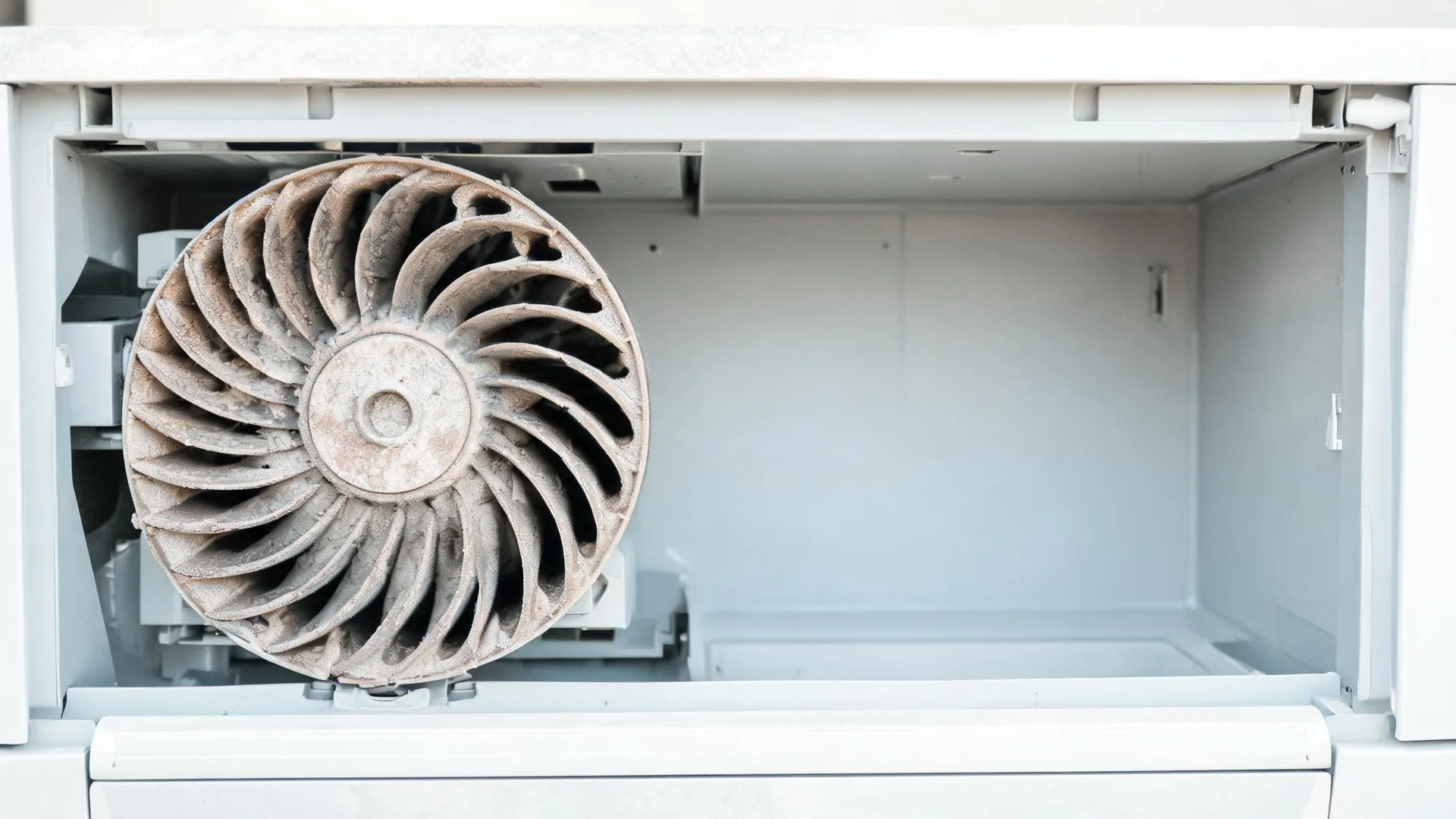
What to leave alone

Don't pull the access panel off the outdoor unit or touch anything inside it. The capacitor in there holds a charge even with the power off and can shock you. Don't keep flipping a breaker that trips again right away, since that usually means a short, not a fluke. If the indoor coil has ice on it, turn the system off and let it thaw rather than running it harder to melt it. Forcing a system that's already struggling tends to turn a repair into a bigger one.

An outdoor air conditioning condenser unit mounted on a concrete pad next to a blue-sided residential house at sunset.

A new air conditioner would cut about $40 a year off cooling for a typical Carroll County home.

  • A new one at the federal minimum, 14.3 SEER2$320 a year
  • An older air conditioner$360 a year

Estimates for a typical Carroll County home, compared with an older unit built to the previous federal minimum, from EIA household energy data, Georgia fuel prices and NOAA climate normals. Your home will differ.

Repair makes sense when a part like a capacitor or contactor has failed.

Replacement makes sense when the compressor has failed or the system uses R-22 refrigerant, which is no longer made.

Not every repair call ends in a repair, and a tech worth listening to will tell you when it doesn't. Age matters less than what's actually worn out. A system can be old and still worth fixing if the problem is one part, like a capacitor or a contactor, that's cheap next to the cost of replacing the whole unit. What changes the math is the compressor. That's the part that actually moves refrigerant and does the cooling, and it's sealed inside the outdoor unit, not something that gets swapped on its own. A failing compressor usually means the whole outdoor unit, sometimes the indoor coil with it, since they're matched to work together. Ask what's actually failed before you ask what it costs. That answer tells you which kind of job you're really looking at.