





A row of single-story houses, one brick and others with pale siding and covered porches, behind a trimmed hedge and lawn, under large oak trees draped with Spanish moss.

AC Repair in Rome, GA

Tell us about the job

Takes about a minute. No obligation.

RepairCentral ACFloyd County, GA
Step 1 of 2

What ZIP code is the job in?

Floyd County saw 115 severe weather events between 2015 and 2024. Most of that was damaging wind, 95 times in that same stretch, along with 6 hail events and 3 tornadoes. An outdoor AC unit sits outside through all of it, with nothing but a thin coil and a fan between it and whatever comes through. Wind-driven debris can bend the fins or crack the fan blade, and hail dents the coil even when the unit still turns on. If a storm has come through and your system never got looked at, it could be running worse than you think.

5 months
May through September, your air conditioner is on duty
89°F
the average summer afternoon it cools against
6 hail events
in ten years, and hail bends the fins on outdoor coils
95 wind events
in ten years, and wind drives debris into outdoor units
Isometric cutaway illustration of a small house showing interior rooms, ductwork, an indoor air handler, and an outdoor condenser unit connected by lines, on a plain white background.
Your air conditioner works hardest from June through September.

NOAA nClimDiv, 1991–2020 normals

AC in Floyd County starts running in May after sitting idle since September.

If your unit has a weak part, the first hot stretch is when it gives out.

At 15.50 cents a kilowatt-hour, a struggling AC runs up your bill all summer

Power here costs 15.50 cents per kilowatt-hour
Climate zone 3A
Cooling runs May through September

Cooling runs about five months here, May through September. Afternoons in June, July and August average 89°F, and the air itself holds more moisture than most of the country deals with, a dew point averaging 67°F. Your AC isn't just lowering the temperature those months, it's pulling that moisture out of the air too, and it does both jobs on most days for nearly half the year. That kind of steady load wears parts down sooner, a capacitor that weakens, a coil that stays damp longer between runs. If something's off with your system now, this is likely why.

If a storm came through, have the unit checked

After wind, hail or a tornado comes through Floyd County, a bent fin or a dented coil doesn't always stop the unit from turning on. Get it looked at before you assume it's fine.

Find a contractor
A man in a dark shirt and tan pants, seen from behind, carries a canvas duffel bag up porch steps toward an orange front door beside a potted shrub.
A gray cylindrical air conditioning condenser unit mounted on a concrete pad next to a light-colored vinyl-sided house exterior.

Five Months In, Something's Worn Through

Five months of steady running adds up. A part that's been weakening all summer tends to finally quit on a day like today, not on a mild one. If your AC is short cycling, blowing warm, or tripping the breaker, that's wear catching up with it, not a one-time glitch. Getting it diagnosed now means whoever looks at it can find the actual part at fault, a failing capacitor, a low charge, a clogged coil, instead of guessing. Fixed right, it'll hold up for whatever's left of the season.

What a failing AC sounds and feels like

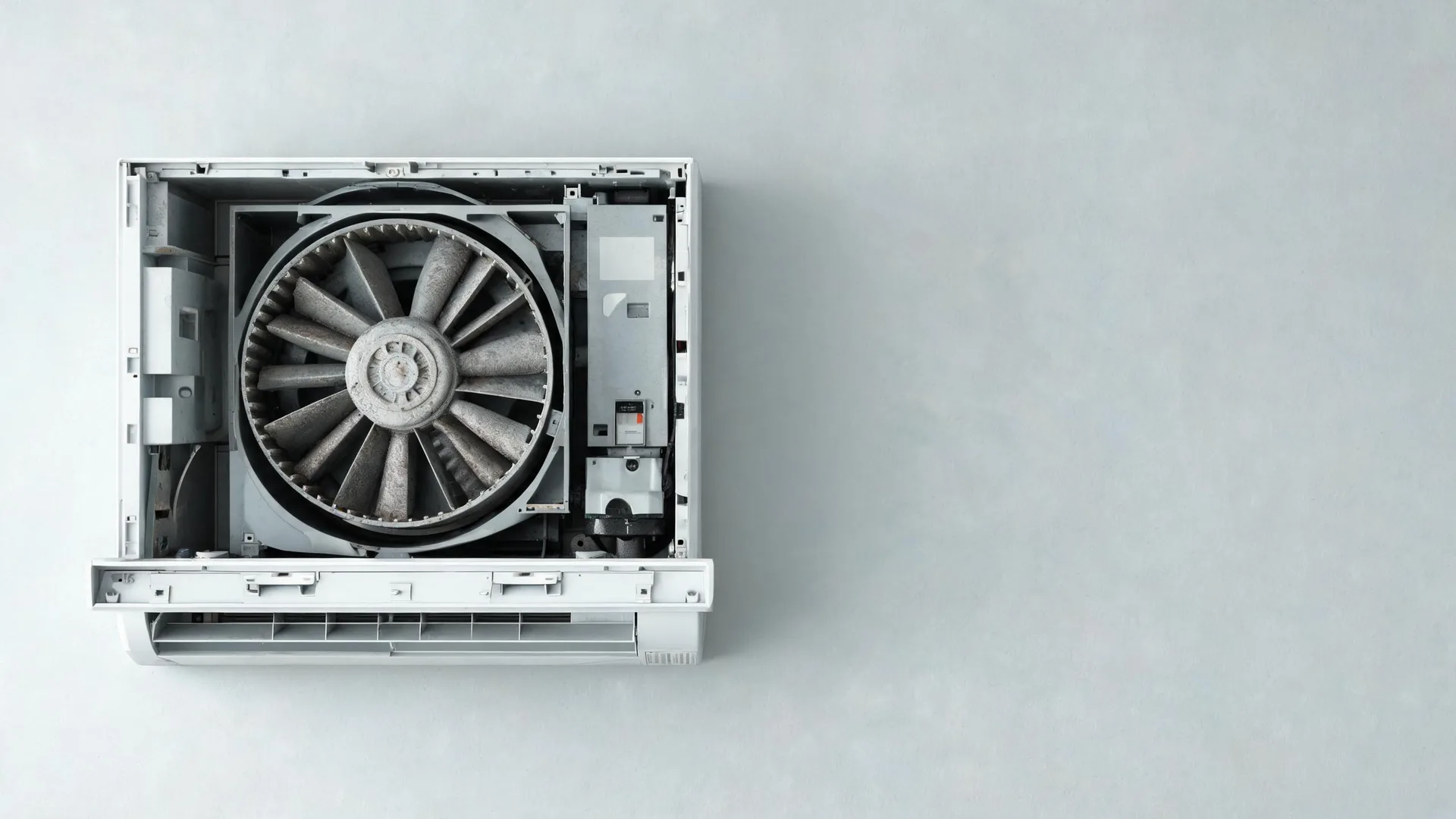
Warm air out of the vents when the thermostat is set low is usually a refrigerant or compressor problem. Short cycling, where the unit shuts off a couple minutes after starting, points to a clogged filter, a dirty coil, or a failing capacitor. Ice on the copper line means airflow is restricted somewhere between the filter and the coil. A unit that trips the breaker on startup is drawing too much current, often from a capacitor that can't give the compressor the push it needs.

Why none of these fix themselves

A weak capacitor gets weaker every time the compressor starts, until one day it can't start it at all. A coil that stays dirty keeps the system working harder to move the same amount of heat, and that strain lands on the compressor itself, the most expensive part to replace. Waiting past the first sign of trouble usually means a bigger repair, not a cheaper one.

Aerial view of a residential air conditioning condenser unit mounted on a concrete pad next to a house with vinyl siding and a sliding glass door.

A new air conditioner would cut about $50 a year off cooling for a typical Floyd County home.

  • A new one at the federal minimum, 14.3 SEER2$340 a year
  • An older air conditioner$390 a year

Estimates for a typical Floyd County home, compared with an older unit built to the previous federal minimum, from EIA household energy data, Georgia fuel prices and NOAA climate normals. Your home will differ.

Repair makes sense when a part like a capacitor or contactor has failed.

Replacement makes sense when the compressor has failed or the system uses R-22 refrigerant, which is no longer made.

A diagnostic visit starts outside, at the condenser. The tech checks the capacitor, the contactor, and the refrigerant charge before anything gets opened up further, because those three cause most no-cool calls. They'll run the system and watch how it starts, whether the compressor struggles or kicks on clean, whether the fan spins freely or drags. Inside, they check the evaporator coil and the airflow across it, since a coil that's iced or caked with dirt will throw off every reading they take. Electrical readings get checked against what the unit is rated for, not guessed at. The point of the visit is to find which part is actually failing, not to replace parts until something works.