
AC tune-up before summer in Warner Robins, GA

Start one form

You're thinking about getting your AC looked at before the heat sets in, not after it quits on you in July. That's the right order. Once summer gets going in Warner Robins, every AC in Houston County is running most of the day, and the contractors who service them get booked out. Calling around now, one company at a time, explaining the same thing about your system over and over, then waiting to see who calls back first, is its own chore on top of the actual work. This page skips that part. Tell it once what you need, and it goes to a contractor local to Houston County who works on home AC systems all season and knows what tends to need attention before the heat hits. Just the one contractor gets your request, not five companies competing for your callback. Use the button below to get started.

The right time for an AC tune-up here is March or April, before the first real stretch of heat. A technician checks refrigerant charge, cleans the condenser coil, tests the capacitor and contactor, and checks airflow across the indoor coil. These are the parts that wear from months of running nearly nonstop once summer sets in, and a weak one won't always show itself until the unit is already working hardest to keep up. A dirty coil makes the compressor run longer to move the same heat. A failing capacitor can mean the whole system won't start on a 95 degree afternoon. Catching that in April means a scheduled visit. Catching it in July means waiting on an emergency call with everyone else in Houston County whose AC picked the same week to quit. The tune-up itself doesn't make summer easier on the unit. It just means you find out what's wearing out before the unit tells you by shutting off.

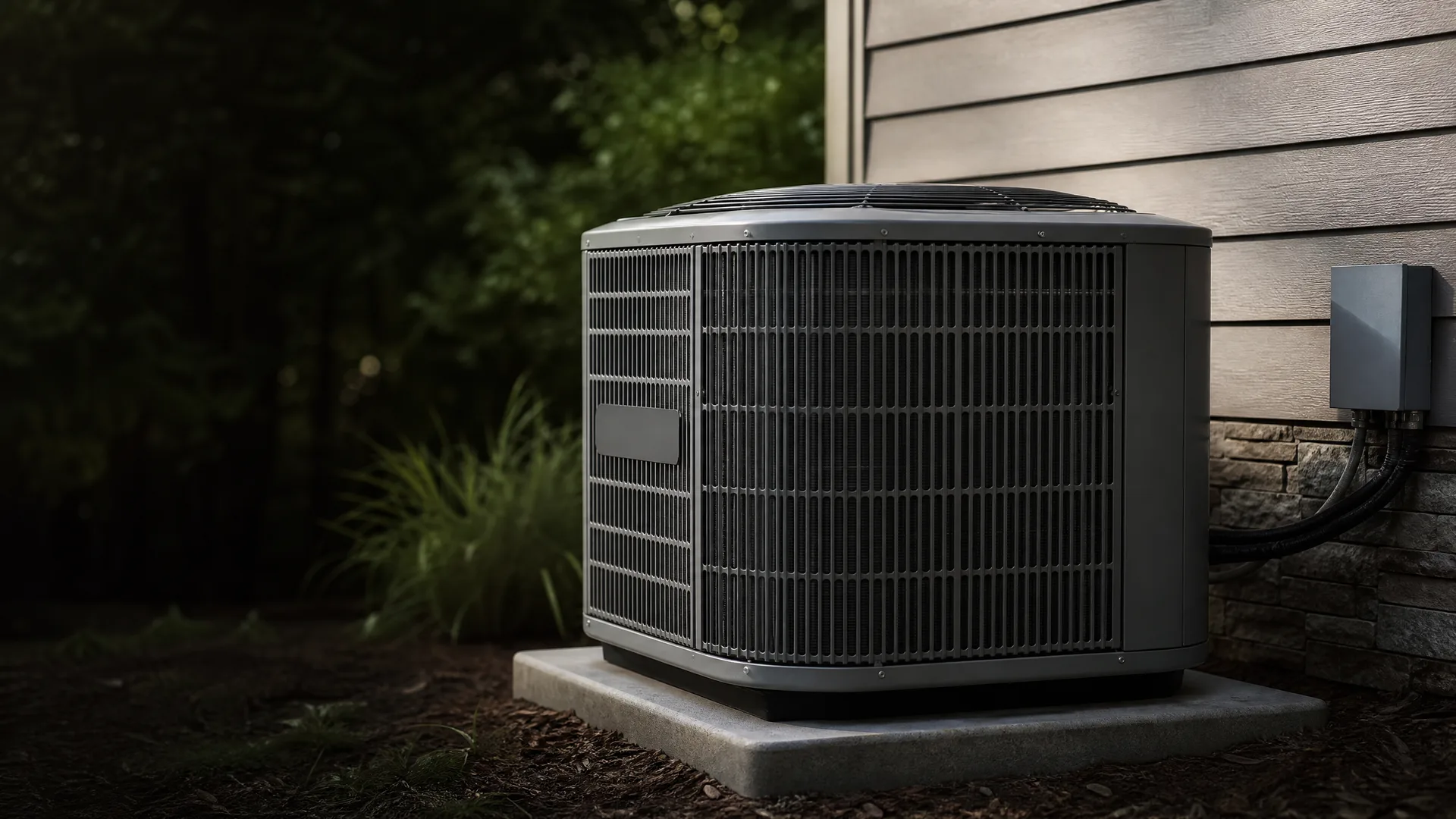
A gray outdoor air conditioner condenser unit on a concrete pad beside a house with white horizontal siding and a brick foundation, with a wall-mounted disconnect box and conduit, and a green shrub with mulch at left.

After a spring tune-up

The coil is clean, the contacts are tight, and the unit cycles the way it should. Airflow across the indoor coil is where it needs to be. When July hits and it's running most of the day, there's nothing hidden working against it.


An outdoor air conditioning condenser unit on a concrete pad beside a house with white horizontal vinyl siding, with a gray electrical disconnect box and refrigerant lines on the wall behind it.

Without one

Dirt builds up on the grille and the coil underneath it. The unit works harder to move the same heat out of your house, and a weak capacitor or dirty coil picks the hottest week to give out. That's when every contractor in Houston County has a backlog.

A closed laptop and a stoneware mug on a wooden table, with a kitchen counter, wood cabinets, white tile backsplash, potted plants and a window behind.

What a skipped tune-up costs you in July

A dirty condenser coil or a weak capacitor doesn't stop your AC cold. It just makes it work harder to do the same job. In Houston County that means longer run times through a stretch of weather that doesn't let up until October, and a power bill that climbs for the same amount of cooling you had last year. The parts under the most strain are the ones a spring check catches early: the capacitor, the contactor, the coil.

The other cost is timing. An AC that's been skipping maintenance tends to fail on the hottest day it's asked to run hardest, which in Warner Robins is usually sometime in July or August. That's also when every other AC in the county is struggling too, so the contractor who could fit you in during a calm week in April is booked solid in the middle of summer. Getting matched with one licensed local contractor now, instead of calling around during a heat wave trying to find anyone with an open slot, is the difference a spring tune-up actually makes.

Interior corner of a room with a dark upholstered sofa and textured cushion, a potted plant, sheer curtains at a multi-pane window showing blurred green and yellow trees, and a dark table holding a wooden tray with stacked coasters and a small ceramic vase.
An outdoor air conditioning condenser unit on a concrete pad beside a house with horizontal lap siding, with an electrical disconnect box and conduit on the wall and a green shrub in the lower left foreground.

The capacitor is the first thing to fail

The capacitor gives the compressor and the fan motor the jolt they need to start. It sits through months of heat and vibration, and that wear adds up. A weak capacitor shows up as a unit that hums but won't start, or a fan that spins slow. A technician tests it under load during a tune-up, not just by looking at it, since a capacitor can read fine sitting still and still fail under the strain of a hot afternoon.

An outdoor air conditioner condenser unit on a concrete pad beside a light stucco wall and vinyl-sided wall, surrounded by gravel.

Airflow across the coil matters most

The indoor coil absorbs heat from the air passing over it, and it can only do that if air is moving through it at the right rate. A clogged filter or a coil with dust built up on it slows that air down, and the system has to run longer to pull the same heat out of your house. Checking airflow means checking the filter, the blower, and the coil itself, not just one of the three.

What does a tune-up actually involve, step by step?

You want to know what you're actually paying for, not just that a tune-up is a good idea. If a technician is going to spend time at your condenser and your indoor unit, you want to know what they're doing during that time and why each step matters, not just a checklist that sounds thorough.

A tune-up follows the same order every time

A technician starts outside at the condenser, checking refrigerant charge against what the unit calls for and cleaning the coil so heat can actually leave the refrigerant. Next comes the capacitor and contactor, the two parts that get the compressor and fan motor running each time the thermostat calls for cooling. Low voltage connections get checked and tightened, since a loose connection generates its own heat over time. Inside, the technician checks airflow across the indoor coil and the condition of the blower. Last comes a full cycle test, running the system and watching how it responds, not just whether it turns on. Each step checks the part most likely to fail before it does.

A woman in a beige V-neck sweater laughs while seated at a white marble counter with a glass of white wine, with a living room containing a gray sectional sofa, lamp, and dark windows behind her.
A woman with long dark hair in a cream sweater laughs while seated at a light stone counter with a glass of red wine, with a blurred dining table and living room behind her.
A woman in a dark green sweater laughs while seated at a marble kitchen island with a glass of red wine, with open shelving, cabinets and a living room visible behind her.
A smiling woman with dark shoulder-length hair in a cream V-neck sweater sits at a marble counter with a glass of red wine, with a kitchen and softly lit living room behind her.

Call around in July

You're checking which outfits still answer, explaining the same problem to each, then lining up quotes while your house sits at 85 degrees.

Skip calling around

One local contractor, now

Someone who works on AC units all over Houston County every spring, who already knows what a Warner Robins summer does to a capacitor or a dirty coil.

Skip calling around
An outdoor air conditioning condenser unit on a concrete pad beside a house with horizontal lap siding, with an electrical disconnect box and conduit on the wall, mulch and a green shrub to the right, and a concrete walkway in the foreground.
Before you get your air conditioner maintenance
A gray outdoor air conditioner condenser unit on a concrete pad beside a house with horizontal siding and a stucco foundation, with a disconnect box and conduit on the wall, decorative gravel, mulch, and a shrub nearby.
After you get your air conditioner maintenance

Skip calling around

A licensed local pro takes the request for your air conditioner tune-up.

No fee to send it, and nothing to sign.

An outdoor air conditioning condenser unit on a concrete pad beside a house with light horizontal siding, its coil fins coated with white cottonwood fluff, surrounded by grass and dense green trees.

The cottonwood fluff is already drifting across the side yard by the time you walk out to check the unit. It's late morning, warm enough that you notice it, not yet the heat that's coming in a few weeks. You crouch by the condenser and see the fins packed white, like a layer of snow caught in the metal. The fan is running but it sounds like it's working for it. You run a finger across the coil and the fluff doesn't budge. It's matted in there, the way it does every spring in Houston County when the trees let go. You straighten up and figure you'll deal with it before the heat really sets in, not after.

A gray outdoor air conditioner condenser unit on a concrete pad beside a house with horizontal lap siding, with a flowering shrub at left and a disconnect box with conduit on the wall at right.
A clear disconnect, a clean coil, a unit that cycles on the first call and holds steady through a July afternoon.
An outdoor air conditioner condenser unit on a concrete pad beside a house with light horizontal vinyl siding, surrounded by bare dirt, gravel and dry leaves, with refrigerant lines and conduit running along the wall.
Leaves packed against the base, lines coated in grime, a coil that can't shed heat the way it did new.
A single-story brick ranch house with a shingled hip roof and dark front door, fronted by a wide asphalt driveway with sun glare, flanked by grass and leafy trees under a pale overcast sky.

Houston County's summer air carries a dew point that averages 69°F across June, July and August, according to NOAA climate records. That's heavy, sticky air, the kind that sits on your skin the second you step outside. Your AC isn't just dropping the temperature in that air, it's wringing the moisture out of it too, and that second job is the harder one. A coil that's dirty or low on charge struggles to pull that humidity down, so the house can hit the number on the thermostat and still feel damp. You'll notice it in how the place feels at 6pm, not just what the dial reads.

NASA POWER T2MDEW

What's your AC telling you right now

Go stand by the condenser for a minute. Does it click on right away, or hesitate before the fan spins up? Is there a hum first, then a pause, then it catches? Inside the house, put your hand near a vent. The air should feel genuinely cold, not just moving. If a room or two runs warmer than the rest, or the unit runs long stretches without the temperature on the thermostat moving much, that's airflow or charge, not your imagination. None of this means it's broken yet. It means it's working harder than it should to keep up, and in a Houston County summer, harder usually turns into a service call during the week you need the house cool most.

  1. Technician shuts power at the disconnect before touching anything

  2. Condenser coil gets cleared of leaves, dirt and grime

  3. Refrigerant charge gets checked against the system's rating

  4. Capacitor and contactor get tested under load

Cooling runs May through September

Five months of that is a long stretch for a unit to run without a break. Your AC isn't cycling off for a week here or there the way it might somewhere with a shorter summer. It runs hard from May to September, so whatever's worn or weak going in has all season to cause trouble.

NOAA nClimDiv 1991-2020

A smiling bearded man in a dark green sweater sits at a dinner table with a glass of red wine, plates of food and a lit candle, with a lamp and houseplant in the dim background.
A woman with dark hair tied up reclines on a sofa with her eyes closed under a gray blanket, with a lit floor lamp, framed picture, and a book beside her in a dim room.

Ready Before the Heat Settles In

  • Getting your AC checked in March or April means it's ready before Houston County's heat and humidity settle in for good.
  • A tune-up catches a weak capacitor or a dirty coil before either one costs you a July breakdown.
  • One licensed local contractor handles the whole visit, so you aren't fielding calls from four different companies.
  • Someone who works on condensers all over Houston County every spring already knows what tends to fail first.
  • The coil, the charge, the capacitor and the airflow all get checked in one visit, not pieced out over several calls.
  • Once that's done, your system is set to run from May through September without something hidden working against it.

You came here asking about a spring tune-up, and the answer hasn't changed through everything above: get it done in March or April, before Houston County settles into the kind of heat that doesn't let up until fall. A technician checks the coil, the charge, the capacitor and the airflow, the same handful of things that tend to fail first on a unit that's run hard every summer for years. Catching a weak capacitor in April costs you an afternoon. Missing it in July costs you a week without air while every other AC in the county is down for the same reason.

What you get out of this is one visit instead of several. A licensed local contractor comes out, looks at what's actually going on with your unit, and handles it, rather than you fielding calls from four companies and explaining the same problem four times. Someone who services condensers across Houston County every spring has already seen what usually goes wrong on units that sit through this kind of summer. That's not a guess about your system, it's what the work teaches anyone who does it season after season here.

Once that visit is done, your AC is set to run from May through September the way it's supposed to. Nothing hidden working against it, nothing left to find out the hard way when the heat actually arrives.

A gray outdoor air conditioner condenser unit on a concrete pad beside a house with horizontal siding and a stone base, with an electrical disconnect box and conduit on the wall and dark foliage in the background.

Describe it once

Tune-up, service, or cleaningCentral ACHouston County, GA
Step 1 of 2

What ZIP code is the job in?