






A nighttime street scene featuring a row of lit white colonial-style houses with wrap-around porches, flanked by oak trees draped in Spanish moss.

Heat Pump Repair in Cartersville, GA

Tell us about the job

Takes about a minute. No obligation.

RepairHeat PumpBartow County, GA
Step 1 of 2

What ZIP code is the job in?

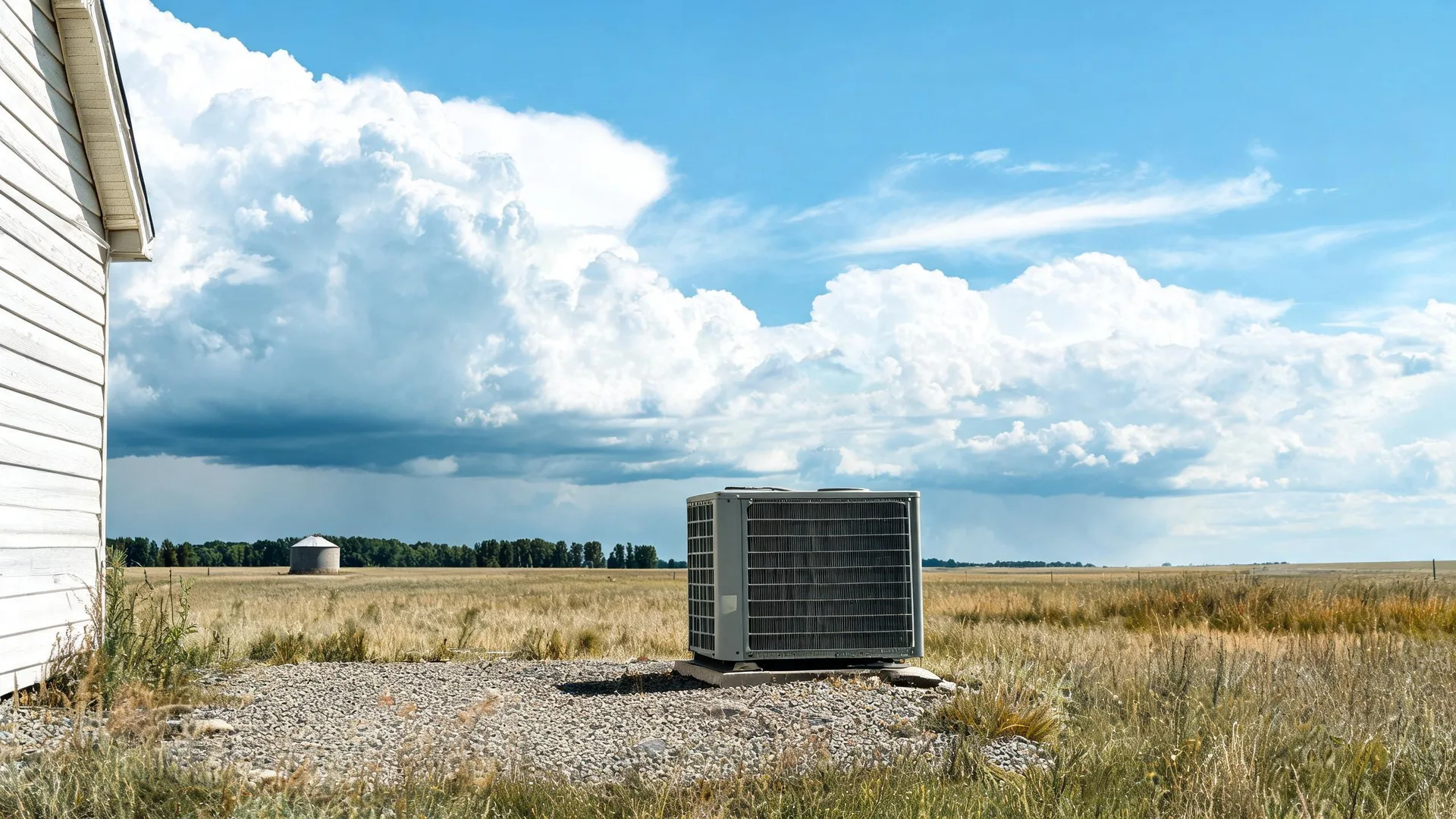
Bartow County saw 117 severe weather events between 2015 and 2024. Most of that was wind, 90 events, with hail hitting 12 times, five tornadoes, four tropical storms and five winter storms mixed in. A heat pump's outdoor unit sits right in the path of all of it, exposed to whatever blows through. Hail dents the fins on the coil, wind drives debris into the cabinet, and a unit can keep running for months afterward while the damage quietly cuts its efficiency or wears on the compressor. If your outside unit took a hit from a storm, it's worth having someone look even if you haven't noticed a problem yet.

7 months
October through April, your system heats
5 months
May through September, it cools
33°F
the average winter night it heats against
88°F
the average summer afternoon it cools against
Isometric cutaway illustration of a single-story house showing interior rooms with furniture, an attic duct system connected to an indoor air handler, and an outdoor condenser unit linked by lines along the exterior wall.
Your system heats October through April and cools May through September.

NOAA nClimDiv, 1991–2020 normals

A capacitor weakens months before it fails outright, so the outdoor fan or compressor struggles to start long before it quits.

A heat pump that hesitates or hums on startup is already telling you which part is going, and waiting just turns a part swap into a compressor job.

Half the homes here were built in 1994 or later, so the heat pump is probably worth fixing

Half the homes here were built by 1994
90 damaging wind events from 2015 to 2024
Power here costs 14.68 cents per kilowatt-hour
Built to run seven months of winterHeat pumps here work October through April, and October is when a weak part finally gives out.

If your heat pump came with the house, check the model and serial number on the outdoor unit before the contractor shows up. That tells a repair tech how old the system actually is, not just the house around it. Half the homes in this county were built in 1994 or later, so there's a good chance the equipment is newer too, with real years of service left in it. A system still within its working life is usually worth fixing rather than writing off. If a compressor or board fails on a unit like that, replacing the part makes more sense than replacing the whole system.

If a storm came through, have the outdoor unit checked

If your outdoor unit has been through hail or wind without a look afterward, get it checked now, before a dented coil or a cracked fan blade turns into a bigger repair.

Find a contractor
A gray outdoor HVAC unit mounted on a concrete pad beside a house with gray lap siding and a stone foundation.

Small problems don't stay small while the unit keeps running

A refrigerant leak is the clearest example. A heat pump low on charge still moves heat, just not enough of it, so the compressor runs longer to make up the difference. That extra runtime is what burns it out. The same goes for a clogged filter or a coil packed with dirt. Airflow drops, the system strains to push past the blockage, and the compressor and the fan motor both carry that load every hour the unit runs. A cracked contactor or a failing capacitor behaves the same way. The part still works, just poorly, so the system keeps calling on it instead of shutting down. None of these start as compressor problems. They end as compressor problems because something smaller was ignored while the system kept cycling on and off around it.

What's safe to check yourself

Look at the thermostat first. Make sure it's set to heat or cool as needed and the batteries aren't dead. Check the breaker box for a tripped switch before assuming the worst. Walk outside and look at the unit. Clear leaves, grass clippings or ice away from the cabinet, since blocked airflow around the coil makes the system work harder for less heat. Check the air filter inside and swap it if it's gray or clogged. A dirty filter chokes airflow the same way a blocked outdoor coil does, and it's the one part you're meant to handle on your own.
What to leave for a tech

Don't open the outdoor unit's electrical panel or touch the refrigerant lines. The capacitors inside hold a charge even with the power off, and refrigerant needs to be handled with the right gauges and recovery equipment. If the system is tripping its breaker repeatedly, that's a sign something downstream is drawing too much current, and resetting it again and again just risks more damage. Ice on the coil, a burning smell or a humming unit that won't start are all signs the problem is past what a homeowner can safely sort out.

A heat pump rarely quits without warning. It tells you first, usually through sound. A clicking that repeats without the unit starting, a hum that trails off instead of catching, or a rattle that wasn't there before all point to a part struggling before it fails outright. Short cycling is another one, where the system turns on and off in quick bursts instead of running a normal stretch. Warm air coming from the vents when it's set to heat often means the system has quietly switched to backup heat because the heat pump itself isn't keeping up. Ice building up on the outdoor coil when it shouldn't be there is a sign the defrost cycle isn't working right. None of these fix themselves, and waiting usually means a smaller part failure turns into a compressor replacement.

Repair and replacement come down to what's failed and what it would take to fix it. A capacitor, a contactor, a fan motor, a defrost board, these are all parts a tech can swap without touching the rest of the system, and doing so brings a working unit back to normal. A compressor is different. It's the heart of the heat pump, sealed and expensive to replace on its own, and when it fails the question becomes whether putting a new one in an older system still makes sense. Age matters here, but so does how the system was maintained. A heat pump that's had regular filter changes and clean coils over the years has an easier time earning out a repair than one that's been run hard with airflow problems ignored. If more than one major part is failing around the same time, that's usually the system telling you it's reaching the end of its working life rather than hitting a single bad patch.