White two-story houses with wraparound porches and Spanish moss-draped oak trees photographed along a residential street at night.

Heat Pump Repair in Griffin, GA

Tell us about the job

Takes about a minute. No obligation.

RepairHeat PumpSpalding County, GA
Step 1 of 2

What ZIP code is the job in?

Spalding County sees real storm damage

Spalding County logged 110 severe weather events between 2015 and 2024. Damaging wind caused 89 of those, and 10 tornadoes touched down in that same stretch. A heat pump sitting outside is in the path of all of it.


The outdoor unit takes the hit

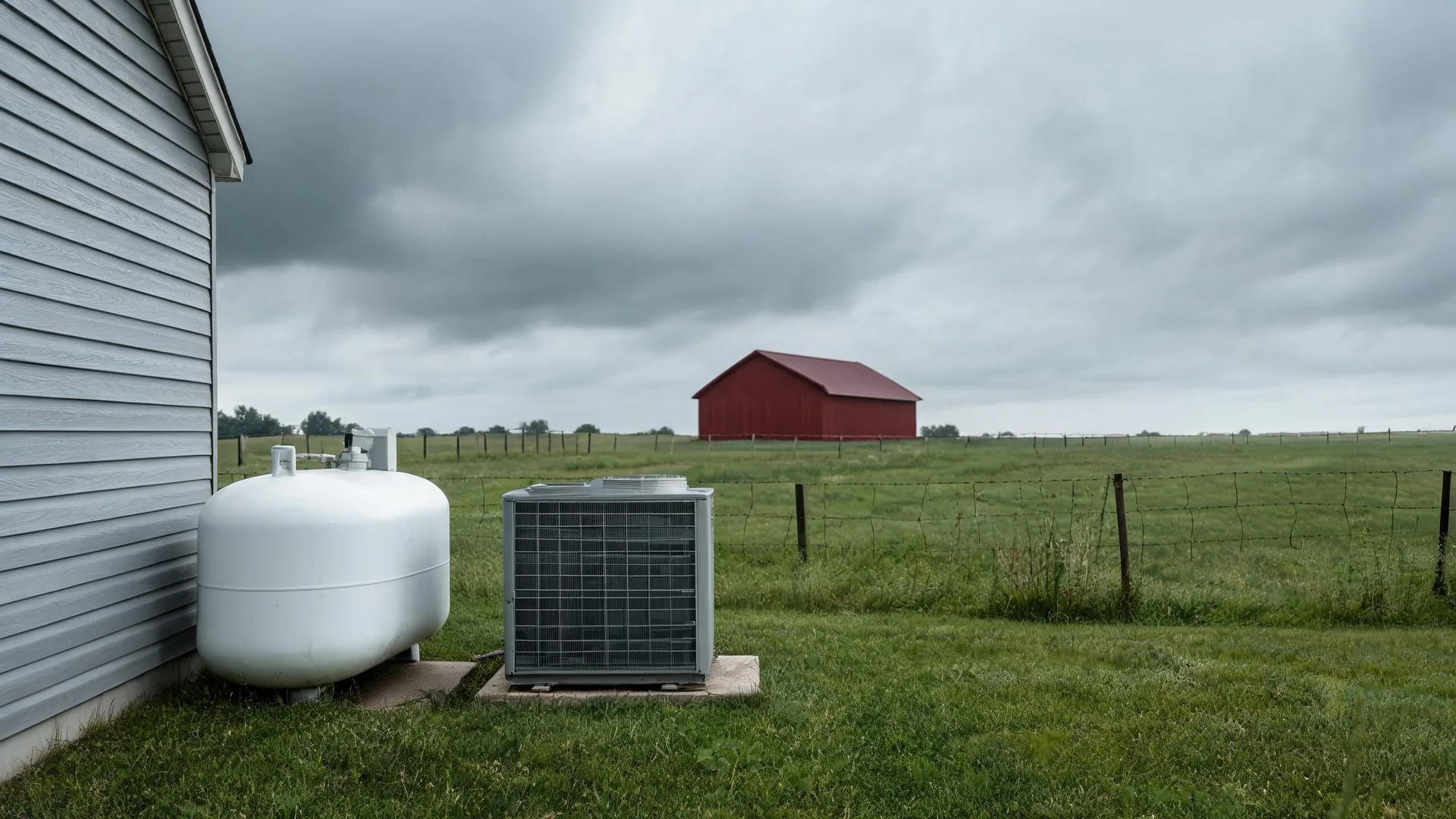
Wind-blown debris and hail can bend the fins on the outdoor coil or crack the fan blade without stopping the unit outright. A heat pump that took a hit from a storm can keep running for weeks before the damage shows up as a real failure.

5 months
November through March, your system heats
5 months
May through September, it cools
36°F
the average winter night it heats against
89°F
the average summer afternoon it cools against
Isometric cutaway illustration of a single-story house showing interior ductwork, an indoor air handler, and an outdoor condenser unit connected by lines along the exterior wall.
Your system heats November through March and cools May through September.

NOAA nClimDiv, 1991–2020 normals

A heat pump makes heat instead of burning fuel for it, so it depends on a refrigerant cycle working correctly in both directions.

When a homeowner notices weak airflow, ice on the outdoor coil, or the system blowing air that isn't quite warm or cool enough, that cycle is struggling somewhere.

Half the homes here were built in 1985 or later, so the heat pump in yours may still be young

Half the homes here were built by 1985
89 damaging wind events from 2015 to 2024
Power here costs 14.76 cents per kilowatt-hour
Built for whatever November bringsHeat here starts in November, and homeowners in Spalding County run it through March.

A diagnostic visit starts before any panel comes off. A technician asks what the system is doing, when it started, and whether it's making noise, running constantly, or not turning on at all. That gets checked against the thermostat settings and a look at the air coming out of the vents. From there it's gauges on the refrigerant lines to see whether the charge is right, a meter on the electrical components to catch a capacitor or contactor that's weak before it fails outright, and a close look at the outdoor coil and fan blade for anything bent, cracked, or iced over. The point isn't just to find what already broke. It's to catch what's about to.

Had a storm come through? Get the outdoor unit checked

If your heat pump has been through a storm, a technician can check the outdoor coil and fan blade for damage even if the system seems to be working fine. Catching a bent fin or cracked blade now is a repair. Leaving it is how a repair turns into a failure.

Find a contractor
A man in a cap, dark shirt and worn brown work pants walks up concrete steps toward an orange front door, carrying a canvas tool bag in his right hand, with a potted shrub beside the entry.
A gray heat pump outdoor unit mounted on a concrete pad next to the stone-accented exterior wall of a house.

Running it doesn't buy you time

A heat pump that's struggling still tries to do the job you're asking of it. If the outdoor coil is iced over, the system keeps calling for the compressor to run, and the compressor keeps trying to push refrigerant through a coil that can't do its part of the exchange. That's how a simple airflow problem turns into a compressor replacement. A fan blade that's cracked but still spinning will keep spinning unevenly until it throws itself off balance and takes the motor bearing with it. A refrigerant leak that's small today is the same leak next month, except by then the compressor has been running low on lubrication for weeks. None of these announce themselves. The system keeps blowing air, so it feels fine, right up until the part that was already failing finishes the job.

Check the thermostat first

Make sure it's set to heat or cool as needed and the batteries aren't dead. A thermostat that lost its schedule or dropped off wifi after a power blip will leave a perfectly good heat pump sitting idle. This takes a minute to rule out and costs nothing to check.

Look at the filter and the outdoor unit

A clogged filter starves the system of airflow and can ice up the indoor coil, so pull it and hold it up to light. Then walk outside and check that the unit isn't buried in leaves, pinned against a fence, or packed with ice or snow. Clear what you can reach by hand. Anything past that, inside the cabinet or in the refrigerant lines, is a job for someone with gauges and training.

Most heat pump failures start with something small that keeps running anyway. A capacitor weakens and the compressor or fan motor starts drawing harder to do the same job, until one day it can't start at all. A contactor pits from years of opening and closing and starts sticking, so the outdoor unit won't kick on or won't shut off. Refrigerant leaks out slowly through a worn fitting, and the system keeps trying to move a full charge with less to work with each week. Dirt builds up on the outdoor coil until it can't shed heat properly, and whatever's pulling double duty to compensate wears out ahead of schedule. The reversing valve that lets the unit switch between heat and cool is also a common failure point, since it works every single cycle, both directions, all year. None of these start as a dead system. They start as a system working harder than it should, which is why catching one early is usually a repair and ignoring it is usually a compressor.

A repair is worth doing when the part that failed is one part, and the rest of the system was running fine before it quit. A capacitor, a contactor, a blower motor, a fan blade: those get replaced on their own, and the heat pump goes back to work like nothing happened. Replacement starts to make more sense when the compressor is the thing that's failed, since that's the heart of the system and the most expensive piece to swap, or when a technician finds a refrigerant leak inside the coil itself rather than at a fitting that can be resealed. Age matters too, but less than how the unit has been treated. A heat pump that's had its filter changed and its coils kept clean can outlast one that's been run hard and ignored, regardless of what year it was installed. The honest question to ask whoever comes out is whether the failure is isolated or whether it's the first of several things about to go. That answer tells you more than a guess ever will.