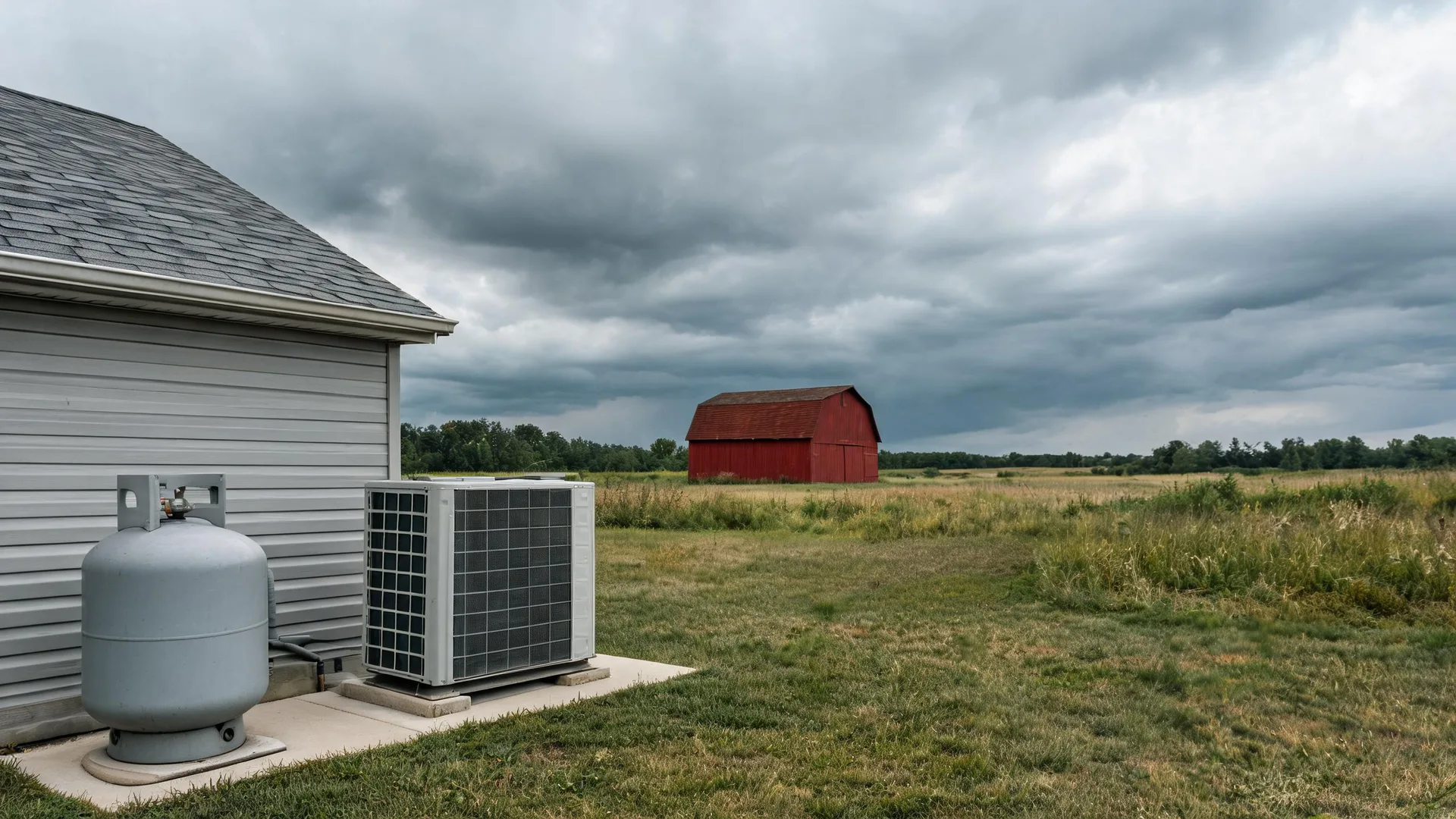
A grey outdoor HVAC unit mounted on a concrete pad beside the beige-sided exterior wall of a suburban house.

Heat Pump Repair in Hinesville, GA

Tell us about the job

Takes about a minute. No obligation.

RepairHeat PumpLiberty County, GA
Step 1 of 2

What ZIP code is the job in?

May is when a weak heat pump shows itself

Heat pumps in Hinesville start carrying the cooling load in May and keep at it through October. A unit that limped through last year on a low charge or a tired capacitor usually will not make it through the first warm stretch without showing a problem.


October is the other test

Come November, the same system switches over to keep the house warm, and it stays on that job through March. If a part was already strained from six months of cooling, the switch to heat is often when it finally gives out, right when the house needs it most.

5 months
November through March, your system heats
6 months
May through October, it cools
41°F
the average winter night it heats against
91°F
the average summer afternoon it cools against
Isometric cutaway illustration of a small house showing interior rooms with furniture, an indoor air handler with ductwork, and lines running to an outdoor condenser unit beside the building.
Your system heats November through March and cools May through October.

NOAA nClimDiv, 1991–2020 normals

Half the houses in Liberty County were built in 1994 or later.

A heat pump installed with a newer house still has years in it, which usually makes repair the right call.

Liberty County sees 128 severe weather events a decade. A heat pump that rode one out still deserves a look.

128 severe weather events from 2015 to 2024
31% of homes statewide lost power a day or more in 2024
99 damaging wind events from 2015 to 2024

A heat pump that's struggling still moves heat, just not well, and that's what tempts people into waiting. But a refrigerant leak doesn't hold steady. As charge keeps dropping, the compressor works harder to do the same job, and it runs hotter than it was built to run. Keep that up long enough and you're not fixing a leak anymore, you're replacing a compressor. The same goes for a failing capacitor. It can still kick the fan or compressor on for weeks, a little weaker each time, until the day it can't start the motor at all and something else takes the strain meant for it. Catching these early is usually a small job. Catching them late usually isn't.

Get the repair looked at, not replaced

If your heat pump came with a newer house here, it's not done yet. Call a contractor out, get the part that's failing named, and let them fix that part instead of the whole system.

Find a contractor
A gray heat pump condenser unit mounted on a concrete pad against the gray lap-siding exterior wall of a house.

What to check before you call

Before anyone comes out, check the thermostat first. Make sure it's set to heat or cool as needed and the set point is actually past room temperature. Then look at the air filter. A filter clogged with dust chokes airflow across the indoor coil, and a heat pump starved for airflow will ice up or struggle to keep temperature no matter what else is right with it. Walk outside and look at the outdoor unit. Clear away leaves, grass clippings or anything stacked against it, since it needs open airflow on all sides to move heat. If you see ice built up on the outdoor coil and it isn't going through a defrost cycle, that's worth noting for whoever comes out. Check that indoor vents are open and not blocked by furniture or rugs. Look at the breaker panel too. A heat pump that won't start at all sometimes just needs a tripped breaker reset, though if it trips again right away, leave it off and let a contractor find out why. None of this fixes a refrigerant leak or a bad capacitor, but it rules out the simple stuff before you pay someone to find it.

What you'll actually notice first

A heat pump in trouble rarely just quits outright. It runs longer than it used to, blows air that feels less warm or less cool than it should, or cycles on and off more than normal. Some rooms stop keeping up while others are fine. You might hear a click where the outdoor unit tries to start and doesn't, or notice it running a defrost cycle more often than seems right. These are the signs people live with for weeks before calling anyone.

Why a working system still needs a look

A heat pump that's low on charge or starting on a weak capacitor can still heat and cool the house, just not well, and that's what makes it easy to leave alone. But a compressor working harder than it should runs hotter than it should, and a capacitor that barely kicks the motor on today will eventually fail to kick it on at all. Left running, a small failing part usually takes a bigger one down with it.

The capacitor is behind a lot of these calls. It gives the compressor and fan motors the jolt they need to start, and it weakens with age and heat until it can't do that anymore. The reversing valve is what lets the unit switch between heating and cooling, and when it sticks, the system keeps doing whatever it was doing last no matter what the thermostat asks for. A low refrigerant charge almost always means a leak in the lines or coil, not the system using up refrigerant on its own. The outdoor coil takes a beating over time from dirt and debris too, and a coil that can't shed heat properly forces the compressor to work past what it was built for. None of these show up as a sudden dead system. They show up as a system that runs longer and keeps up less, right until the day it doesn't.

Repair and replace both have their place, and the difference usually comes down to what's actually failing. A capacitor, a contactor, a blower motor, a reversing valve, these are parts a contractor replaces on their own, and doing that brings the system back to normal without touching anything else. A compressor is different. It's the most expensive part in the unit, and it's also the part that tells you the system has been struggling for a while before it finally gave out. When a compressor fails, or when the coil it depends on is corroded through, a contractor will usually walk you through replacing the unit instead of chasing a repair that won't hold. The question worth asking isn't just what broke, it's why it broke. A capacitor that failed from age is a capacitor problem. A compressor that failed because it ran low on charge for months is a bigger conversation.