An outdoor HVAC condensing unit on a concrete pad next to a beige single-story house with a dark shingle roof.

Heat Pump Repair in Jefferson, GA

Tell us about the job

Takes about a minute. No obligation.

RepairHeat PumpJackson County, GA
Step 1 of 2

What ZIP code is the job in?

Humid air, but not an extreme load

Summer dew points in Jackson County average 67°F, which feels heavy, but the county still falls in a warm, zone 3A climate rather than the harsher zones further south. A heat pump here works long hours in summer, not brutal ones.

What that means for a repair call

A heat pump that hasn't been run into the ground by extreme heat or deep cold usually has more life left in its coil and compressor. When something goes wrong here, age or a neglected filter is a more likely cause than the system simply being worn out from the climate.

6 months
November through April, your system heats
5 months
May through September, it cools
35°F
the average winter night it heats against
88°F
the average summer afternoon it cools against
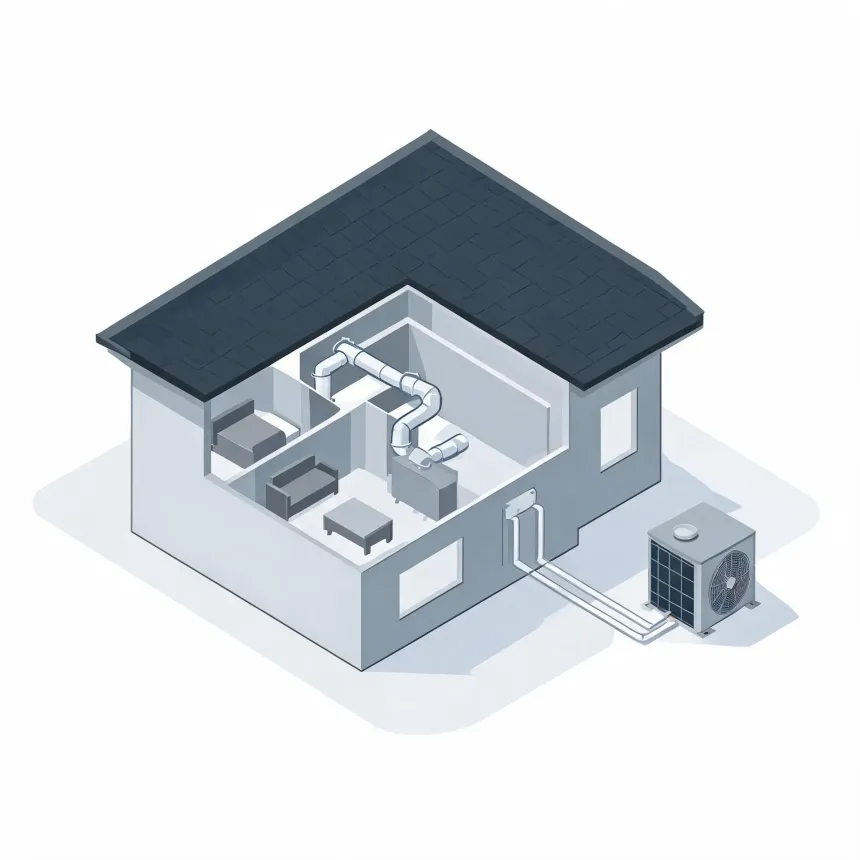
Isometric illustration of a cutaway single-story house showing interior ductwork, an indoor air handler and simple furniture, connected by lines to an outdoor condenser unit beside the building.
Your system heats November through April and cools May through September.

NOAA nClimDiv, 1991–2020 normals

A heat pump losing refrigerant keeps running, but the compressor was built to pump a full charge, not a partial one.

Let it run low and the compressor works harder to move what little refrigerant is left, so a cheap fix turns into a compressor replacement.

Half these homes were built this century, and so were their heat pumps

Half the homes here were built by 2002
Power here costs 14.03 cents per kilowatt-hour
Climate zone 3A

November is when heat kicks on here, so the first cold mornings are when a weak part finally gets tested. Overnight lows average 35°F through December, January and February, and a heat pump has to work against that every night, not just once. If a capacitor or a contactor was already marginal, that first real cold snap is what finishes it off. The same thing happens in reverse come May, when cooling starts back up after sitting idle all winter. A system that struggled at the end of last season usually shows it again at the start of the next one, before it's run long enough to call it new trouble.

A heat pump that's had an easier life is usually worth repairing

A system that has been worked hard, not worn out, is usually a good candidate for repair instead of replacement. Getting it looked at now means finding out which part failed before it takes anything else with it.

Find a contractor
A man in a gray long-sleeve shirt and work pants carries a canvas tool bag as he climbs porch steps toward an orange front door of a gray clapboard house, with a potted shrub to the right.
A dark gray heat pump unit mounted on a concrete pad next to a house with gray siding and a stone veneer wall.

How long this one's been running matters more than the season

Half these systems went into houses built since 2002, which means plenty of them are still within the stretch of life a heat pump is built for. If yours came with the house, that's worth finding out before you decide how far to go with a repair. A compressor or a coil only a few years into service is worth putting money into. Ask the contractor straight: is this part worth fixing on a system this age, or is it already near the end.

What you can check before anyone comes out

Look at the thermostat first. Make sure it's set to heat or cool as needed and the batteries aren't dead. Check the outdoor unit for anything blocking it, leaves, a fallen branch, ice buildup, or grass clippings packed against the coil. Pull the air filter and hold it up to a light. If you can't see through it, swap it or wash it if it's the reusable kind. Walk the vents in the house and make sure none are closed or blocked by furniture. Check the breaker panel for a tripped switch before assuming the unit itself failed.

What tells you to stop and wait for a tech

If the outdoor unit is coated in ice beyond a thin morning frost, don't knock it off or run a hose on it. Turn the system off and call. The same goes for a burning smell, a breaker that trips again right after you reset it, or the outdoor fan not spinning while the indoor blower runs. Those point to an electrical fault or a refrigerant problem, and running the system in that state usually turns a repair into a bigger one. A system blowing air that's not warm or cool enough is fine to leave running while you wait for someone, but one making a grinding or screeching noise should be shut off.

A heat pump fails in a handful of predictable ways, and most of them give some warning first. The contactor, a small switch that sends power to the outdoor unit, pits and burns with use until it sticks or stops closing. A capacitor weakens over time and can no longer give the compressor or fan motor the jolt it needs to start, so the fan may hum but not spin. The reversing valve, which lets the system switch between heat and cool, can stick in one position after years of use, and that shows up as a system that heats fine but won't cool or the other way around. Dirty coils make the whole system work harder, since a coil caked in dust or grime can't move heat the way a clean one does, and that strain shortens the life of the compressor. The compressor itself rarely fails on its own. It usually goes after something else was already wrong and wasn't caught in time.

Repair versus replacement comes down to what's actually wrong and what else is riding on it. A contactor or capacitor is a small, inexpensive part, and swapping it doesn't say anything about the rest of the system. That kind of repair almost always makes sense. A compressor is different. It sits at the center of the system, and replacing one costs enough that it's worth asking what else is near the end of its life before you commit to it. The question isn't just what broke, it's whether the system has been maintained along the way or run hard with problems that went unaddressed. A heat pump that's had clean coils and regular filter changes tends to fail one part at a time, and those failures are worth fixing as they come. One that's been neglected tends to fail in a cascade, where fixing the obvious problem just uncovers the next one. A contractor looking at the failed part should be able to tell you which kind of situation you're in.