






White plantation-style houses with wraparound porches lit at night, surrounded by Spanish moss-draped live oak trees.

Heat Pump Repair in Macon-Bibb County, GA

Tell us about the job

Takes about a minute. No obligation.

RepairHeat PumpBibb County, GA
Step 1 of 2

What ZIP code is the job in?

November is when heat first has to run here, and a heat pump that was never quite right tends to show it that first cold week. A weak contactor or a low refrigerant charge can sit quiet for months with no real load on the system. It stops sitting quiet once the house needs steady heat through the winter. The same thing happens at the other end, in May, when cooling starts up after five months of not running at all. Getting a repair looked at in October or April, before the switch, means the problem gets found before the system has to carry the season on a bad part.

5 months
November through March, your system heats
5 months
May through September, it cools
36°F
the average winter night it heats against
91°F
the average summer afternoon it cools against
Isometric cutaway illustration of a small house showing ducted air distribution, an indoor air handler, and an outdoor condenser unit connected by lines, with a sofa and bed in the rooms.
Your system heats November through March and cools May through September.

NOAA nClimDiv, 1991–2020 normals

A heat pump that trips its breaker will keep trying to restart on its own.

Each short cycle heats the compressor windings a little more, and that's what burns them out for good.

Half these homes date to 1977 or earlier, but that's not what's wearing out your heat pump

Half the homes here were built by 1977
Power costs 14.08 cents a kWh statewide
Climate zone 3A

A tech starts by asking what the system is doing and when it started acting up. Heating, cooling, or neither matters, because that points to different parts. Thermostat settings get checked first, since a wrong setting can look like a real failure. Then it's gauges on the refrigerant lines, a look at the outdoor fan and coil, and a check of the contactor and capacitor, since those electrical parts tend to fail before anything else does. If the system runs but doesn't heat well, the reversing valve gets checked, since that's the part that switches the system between heating and cooling and it can stick partway. Airflow gets checked too, at the filter and the indoor coil, because weak airflow can look exactly like a refrigerant problem without being one. A good diagnostic ends with the tech pointing to the actual part that failed and saying what it's doing to the rest of the system.

Get it looked at early

Problems tend to show up in the first weeks of the season, when the load hits a part that was already weak.

Find a contractor
A man in a cap, dark T-shirt and work pants carries a worn canvas tool bag up wooden porch steps toward a red front door.
A white mini-split heat pump outdoor unit mounted on a concrete pad beside a gray-sided house, surrounded by gravel and green shrubs.

The hours add up on the parts that run the most

A heat pump that runs most of the year shows wear differently than a furnace that only runs part of it. The outdoor unit sits outside through everything, rain, heat, cold, and the fan motor and coil take that exposure every day the system runs. Short cycling is usually the first thing an owner notices, the system kicking on and off in quick bursts instead of running a steady stretch. Weak heat is another, air coming out of the vents that isn't cold or warm enough to matter, which often means the system is stuck between modes or losing refrigerant slowly. Ice on the outdoor coil that doesn't clear on its own points to a failing defrost control or a fan that's stopped pulling air across it. A compressor that hums but doesn't start, or clicks and shuts back off, is usually a capacitor going bad, and that part tends to fail after it's been under load for a long stretch rather than at the start of a season. None of these show up all at once. They show up as the system keeps logging hours, and the part that was already marginal finally gives out under the demand.

Outdoor and indoor parts fail in different ways

The outdoor unit takes the weather every day it runs, so its fan motor bearings and the coil fins are usually first to wear. Indoors, the blower motor and the circuit board tend to go from age and dust rather than exposure. A system that heats fine but blows weak air is probably an indoor problem. One that short cycles or won't hold a cycle outside is more likely the outdoor side.
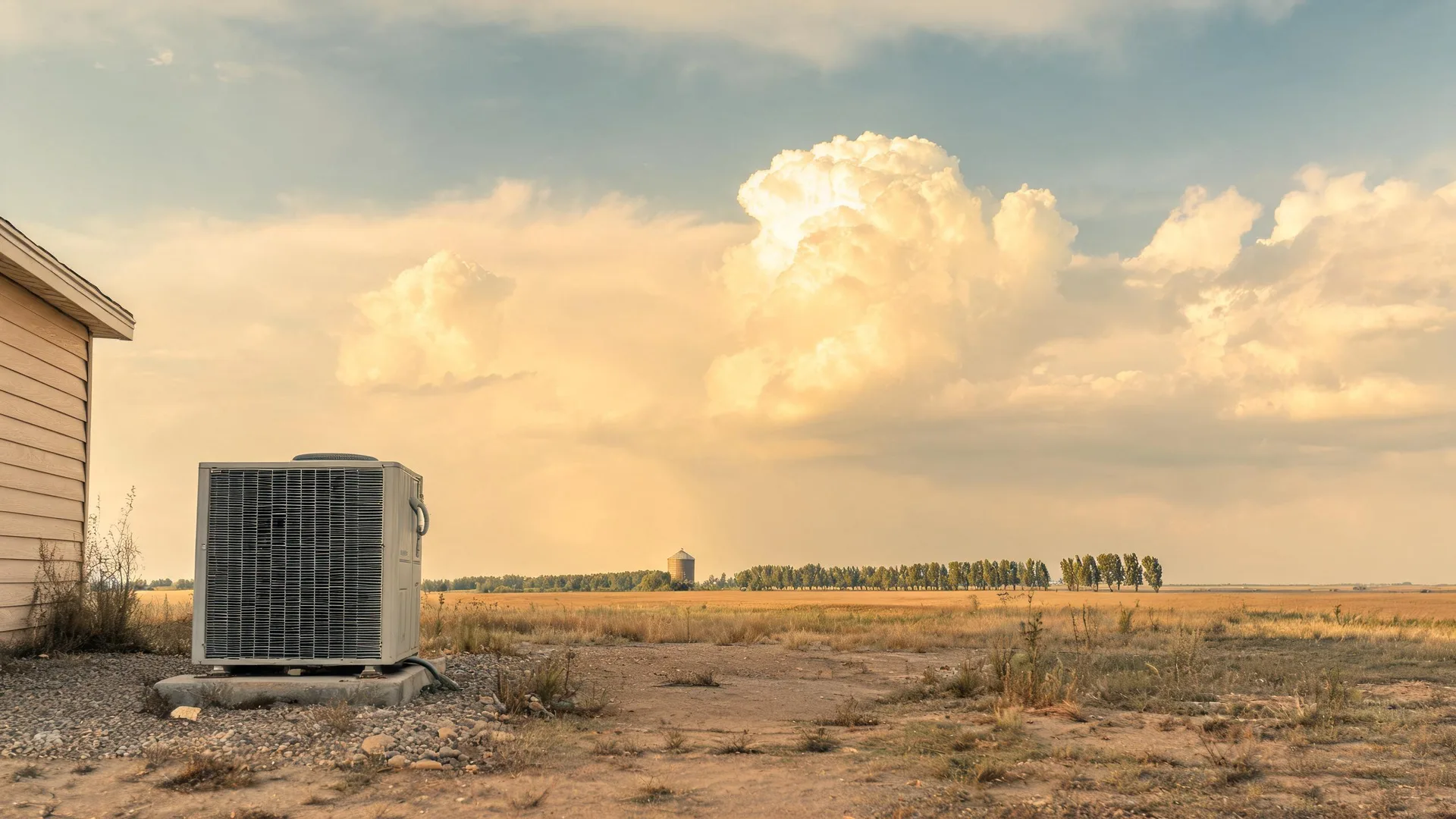
Refrigerant charge rarely drops all at once

A heat pump doesn't use up refrigerant. If the charge is low, it's leaking out somewhere, usually at a fitting, a coil, or a line joint that's worked loose over time. A small leak can run for a long while before it's bad enough to notice, which is why a system can seem fine one season and struggle the next without anything else changing.

Before calling anyone, check the thermostat is actually set to heat or cool, not just on. It sounds obvious but it's the most common false alarm there is. Next, look at the outdoor unit. If it's caked in ice, covered in leaves, or the fan isn't spinning, that's worth noting, but don't chip the ice off yourself or stick anything near the fan. Inside, pull the filter and hold it up to a light. If you can't see through it, that's restricting airflow enough to cause real problems on its own. Check the breaker. If it's already tripped, leave it alone rather than resetting it, since a breaker that trips once is usually telling you something underneath is actually wrong. If the system is running but the air doesn't feel like it's doing anything, that's not something a homeowner can chase further, and it's time to call.

A repair is worth doing when one part failed and the rest of the system is sound, the compressor still turns over fine, the coils are clean, and it's a contactor or a capacitor or a motor that's gone. Replacement starts to make more sense when the compressor itself is the problem, since that part sits at the center of the system and a failing one usually means the refrigerant lines and coils have been running under strain too. Age matters less than how the system has been running. A unit that's been short cycling or losing charge slowly for a while has usually put stress on parts beyond the one that just failed. A tech can tell you which it is by checking whether the failure is isolated or whether it points to the compressor or the coil underneath it. If it's one part in an otherwise sound system, fixing it is the straightforward answer.