A row of single-story cottages, one brick and the others light gray siding with covered porches, behind a trimmed hedge and lawn, under large oak branches draped with Spanish moss.

Heat Pump Repair in Rincon, GA

Tell us about the job

Takes about a minute. No obligation.

RepairHeat PumpEffingham County, GA
Step 1 of 2

What ZIP code is the job in?

Check the thermostat and the breaker first

Make sure the thermostat is set to heat or cool as needed and the batteries are good if it uses them. Check the breaker panel for the heat pump and the air handler, since a tripped breaker on either one will shut the whole system down. Look at the outdoor unit too. If the breaker keeps tripping again after you reset it, stop and leave it alone.


What you find changes the call

A dead thermostat or a tripped breaker might be something you fix yourself in a minute. Ice covering the outdoor coil, a compressor that hums but won't start, or a system blowing cold air during a heating cycle all point to something inside the unit that needs a licensed tech. Knowing which one you're looking at before you call means the contractor shows up with the right idea of what's wrong.

5 months
November through March, your system heats
6 months
May through October, it cools
39°F
the average winter night it heats against
91°F
the average summer afternoon it cools against
Isometric line illustration of a cutaway house showing interior rooms with furniture, ceiling ductwork, and an outdoor condenser unit connected by lines along the exterior wall.
Your system heats November through March and cools May through October.

NOAA nClimDiv, 1991–2020 normals

Heat here kicks on in November, right when cold hits a heat pump for the first time since spring.

A weak part that made it through summer easy enough often won't make it through that first cold snap.

Half the homes in Effingham County were built in 2001 or later. If yours is one of them, the heat pump probably isn't that old either, especially if it came with the house. A repair is usually worth it on a system in that range. Most of what goes wrong, a bad capacitor, a stuck reversing valve, a low refrigerant charge, gets fixed without replacing the whole unit. Worth asking the tech how old the system actually is before you decide anything.

Storms here are hard on outdoor units. Have yours checked.

Effingham County saw 161 severe weather events between 2015 and 2024, with damaging wind in most of them. An outdoor heat pump unit sits through all of that, exposed to hail and flying debris. A system that still runs can have a bent coil fin or a cracked fan blade from a storm that passed months ago. If yours took a hit and nobody's looked at it since, that's worth checking now.

Find a contractor
A man in a dark shirt and brown pants, seen from behind, carries a waxed canvas tote bag up wooden porch steps toward an orange front door, with a potted shrub beside the entry.
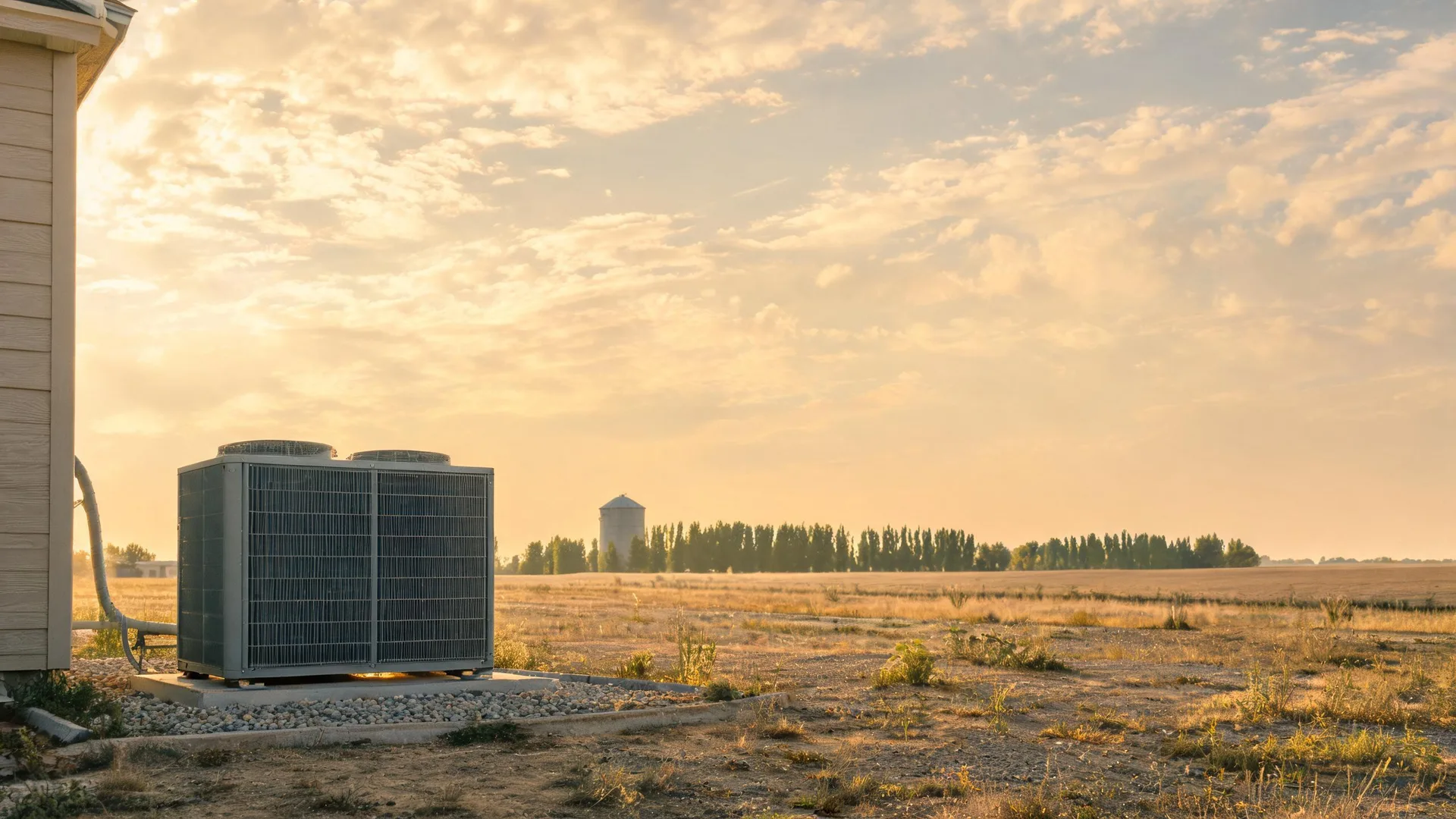
A gray heat pump condenser unit mounted on a concrete pad against the gray lap-siding exterior wall of a house.

Between the weather and the workload, this unit earns its wear

This heat pump runs on the hot days and the cold ones, and the outdoor unit never gets a break from the weather in between. Effingham County logged damaging wind 116 times from 2015 to 2024. Add that to the regular wear of running most of the year, and parts give out sooner than they would somewhere calmer. A fin bent last spring or a connection shaken loose months ago does not usually show up as a slow decline. It shows up as a breakdown on the morning you need the system most.

The reversing valve fails in ways a straight AC never does

The reversing valve is the part that switches a heat pump between heating and cooling, and it can get stuck partway or stop shifting at all. A valve starting to go often shows up first as weak heat rather than no heat at all, since the system is still running, just not switching fully.

Everything else fails the way it does in any AC system

A capacitor weakens until it can't start the compressor or the fan motor. A contactor pits and sticks after years of opening and closing. Refrigerant leaks slowly at a fitting or a coil seam, and the system runs longer each cycle to keep up before anyone notices. None of this announces itself. It just makes the unit work harder until it stops.

Most heat pump failures show up as a change you can feel, not a system that quits outright. Air coming from the vents that isn't as warm as it used to be, a unit that runs longer than it should to reach the set temperature, or short cycles where it kicks on and off every few minutes instead of running a steady stretch. A hissing or bubbling sound near the outdoor unit points to refrigerant, not something to wait on. A burning or musty smell from the vents is worth shutting the system off for until someone looks at it. Ice on the outdoor coil that doesn't clear on its own during a defrost cycle means something isn't switching right. Any grinding or screeching from the outdoor unit means a motor bearing is on its way out, and that part won't fix itself by running less.

A compressor is the part that turns a repair into a bigger decision. Everything else, a failed capacitor, a bad contactor, a stuck reversing valve, gets replaced on its own without touching the rest of the system. A compressor is different. It sits at the center of the sealed system, and swapping it costs close to what a new outdoor unit costs, so a tech will usually walk through replacement alongside repair once that's the part that's bad. A compressor old enough to fail once is also more likely to fail again, even after a repair. Refrigerant leaks fall in between. A leak at a fitting or a coil seam gets fixed and recharged. A leak from inside the coil itself is a different job, and worth asking about directly rather than assuming it's a quick patch.