A nighttime street scene featuring a row of lit white colonial-style houses with wrap-around porches, flanked by oak trees draped in Spanish moss.

Heat Pump Repair in Thomasville, GA

Tell us about the job

Takes about a minute. No obligation.

RepairHeat PumpThomas County, GA
Step 1 of 2

What ZIP code is the job in?

What the repair history tells you

A heat pump that's had one compressor or control board replaced in its life is a different machine than one a contractor keeps coming back to for the same kind of failure. Repeated trips for refrigerant leaks, a reversing valve that sticks, or a board that keeps frying point to a system that's wearing out past the part that keeps failing. A single repair on a unit that's otherwise been reliable is usually just that, a single repair.


What a failing compressor changes

The compressor is what makes a heat pump a heat pump, and it's the one part that isn't practical to swap on its own in most cases. If a contractor traces the problem there, the conversation usually shifts from repair cost to replacement, because a new compressor often runs close to what the rest of the system is worth. Problems with the fan motor, capacitor, or defrost control don't carry that same weight.

5 months
November through March, your system heats
6 months
May through October, it cools
41°F
the average winter night it heats against
91°F
the average summer afternoon it cools against
Isometric line illustration of a cutaway single-story building showing interior rooms, ceiling ductwork, an indoor air handler, and an outdoor condenser unit connected by refrigerant lines.
Your system heats November through March and cools May through October.

NOAA nClimDiv, 1991–2020 normals

Heat here starts up in November.

A heat pump that's been sitting idle since March often shows its weak spot in the first cold snap, not before.

Half the homes in Thomas County were built in 1987 or later, so a lot of these heat pumps are still within their working life

Half the homes here were built by 1987
Power costs 14.08 cents a kWh statewide
Climate zone 2A

Thomas County logged 129 severe weather events between 2015 and 2024, and most of that was damaging wind. That's the outdoor unit's exposure right there, sitting outside to take whatever comes through. Hail events in the same stretch mean dented fan grilles and bent coil fins aren't rare here. A heat pump can keep running after hail or wind debris hits the cabinet and still have a coil that's losing efficiency or a fan blade that's out of balance. Add in how many Georgia homes lose power for a day or more in a given year, and you've got a system that depends on that outdoor unit restarting clean after every outage, not just surviving the storm itself. If yours took a hit and kept running, that's not the same as being fine.

Get the heat pump looked at before you assume it's done

If your house went up in 1987 or later, the heat pump likely came with it, or close to it, and it's probably still within its working life. That's a reason to get it looked at, not replaced. A tech can tell you in one visit whether this is a fan motor or capacitor, or something bigger.

Find a contractor
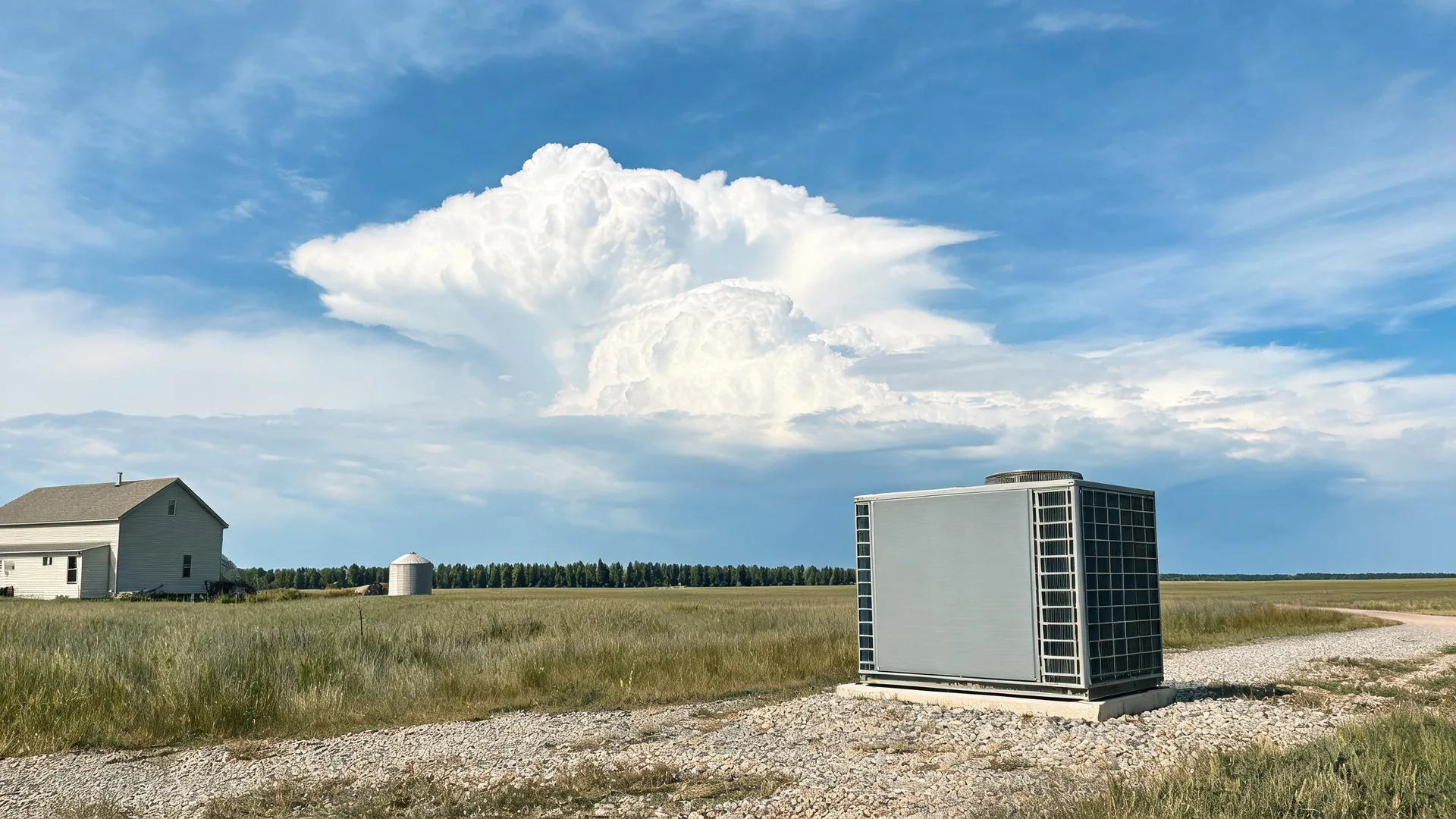
A gray heat pump outdoor unit mounted on a concrete pad next to the stone-accented exterior wall of a house.

What shows up first, and what it's telling you

A heat pump runs in both directions, all year, so the wear shows up in places a furnace or straight air conditioner never touches. The reversing valve that switches it between heating and cooling is one of the first places that trouble shows. If the system is blowing air that's warm when it should be cold, or cold when it should be warm, that valve is a likely spot to check. Short cycling, where the unit kicks on and off in quick bursts instead of running a full cycle, points to a thermostat problem, a refrigerant issue, or a compressor that's struggling to start. Ice building up on the outdoor coil during the heating months is normal in small amounts, since the unit defrosts itself on a schedule, but a coil that stays frosted over means the defrost control or a sensor isn't doing its job. Listen for it too. A heat pump that starts rattling, clicking repeatedly before it kicks on, or buzzing from the outdoor unit usually has a failing capacitor or a motor on its way out. None of these mean the system is finished. They mean something specific inside it needs attention, and most of those parts can be replaced on their own.

A refrigerant leak doesn't stay small

A heat pump low on refrigerant keeps running, but the compressor has to work harder to move heat with less of it on hand. Run it like that long enough and the compressor overheats or wears out early, turning a leak into a bigger repair than it started as.

A weak capacitor still starts the motor, until it doesn't

A capacitor that's losing strength still gets the compressor or fan motor going most of the time, so nothing seems wrong yet. Each hard start heats the motor windings more than a clean one would. Swapped out early, it's a small job. Left alone, it can take the motor with it.

Before anyone comes out, there's a short list worth checking yourself. Look at the thermostat first. Make sure it's set to heat, not cool or fan only, and that the setting is actually above room temperature. Check the breakers for the indoor air handler and the outdoor unit, since either one tripping will shut the whole system down. Walk outside and look at the outdoor unit itself. If leaves, pine straw, or a fallen branch are packed against the coil or blocking the fan, clear it away, since restricted airflow alone can make a heat pump act like it's failing. Check the air filter too. A filter clogged with dust chokes off airflow the same way outdoor debris does, and it's one of the few things that causes real problems while costing nothing to fix. If the system still isn't heating right after that, you've ruled out the easy causes and whatever's left is worth a tech's time.

A diagnostic visit starts with the complaint, not the unit. A tech will ask what it's doing, when it started, and whether it's heating, cooling, or blowing air that doesn't match the setting, because that narrows where to look before a panel ever comes off. From there it's gauges on the refrigerant lines, a meter on the electrical components, and a close look at the outdoor coil and fan. Static readings tell a different story than running readings, so expect the system to be watched through at least one full cycle rather than just checked while it's sitting idle. If the reversing valve is the suspect, the tech will listen to it shift and feel the line temperatures change, since a valve that's stuck or leaking internally shows up that way before it shows up on a gauge. The visit ends with a specific part named, not a vague verdict.