A red brick single-story house with a covered porch and adjacent cream-sided houses behind a trimmed hedge and lawn, framed by large oak trees draped with Spanish moss under an overcast sky.

Heat Pump Repair in Winder, GA

Tell us about the job

Takes about a minute. No obligation.

RepairHeat PumpBarrow County, GA
Step 1 of 2

What ZIP code is the job in?

Your heat pump isn't fighting the climate here

Barrow County sits in a warm zone with a long cooling season and winters that stay mild. A heat pump here doesn't work as hard as one up north, where the outdoor unit has to pull heat from much colder air for months at a time. Less strain year after year means less wear on the compressor and the coils.


So a repair is usually the right call

When a heat pump has had an easier run, trouble is more likely to trace back to one bad part, a dirty coil, or a system that got skipped on maintenance, not a unit that's worn out from overwork. That's worth knowing before anyone tells you to replace it. Fixing what's actually wrong is often the straightforward answer here.

6 months
November through April, your system heats
5 months
May through September, it cools
35°F
the average winter night it heats against
88°F
the average summer afternoon it cools against
Isometric cutaway illustration of a single-story house showing interior rooms with furniture, an attic duct system connected to an indoor air handler, and an outdoor condenser unit linked by lines along the exterior wall.
Your system heats November through April and cools May through September.

NOAA nClimDiv, 1991–2020 normals

A few checks take five minutes and rule out the easy stuff.

Check the thermostat settings and the breaker before you assume the worst.

Half the homes here were built this century, and so was what's heating them

Half the homes here were built by 2001
Climate zone 3A
Power here costs 14.04 cents per kilowatt-hour

Heat comes on here in November, and that first stretch of cold is when a weak part tends to fail. A heat pump that's been limping along on a tired capacitor or a low charge can coast through a mild fall without showing it. Once overnight lows settle in for the winter, averaging 35 degrees across December, January and February, the system has to run longer to keep up, and whatever was already marginal gets found out. October, the month before heat season starts, is a better time to have it looked at than waiting for the first hard night. The same holds in spring. Cooling starts in May, and April is a better month to catch a problem than the first humid week the system has to run flat out.

An easier life here means repair usually makes sense

A heat pump that hasn't been run into the ground is usually worth fixing rather than replacing. Get the part that's actually failing diagnosed and repaired, and it should keep going.

Find a contractor
A man in a dark long-sleeved shirt and brown work pants, seen from behind, climbs porch steps toward an orange front door while carrying a canvas tool bag.
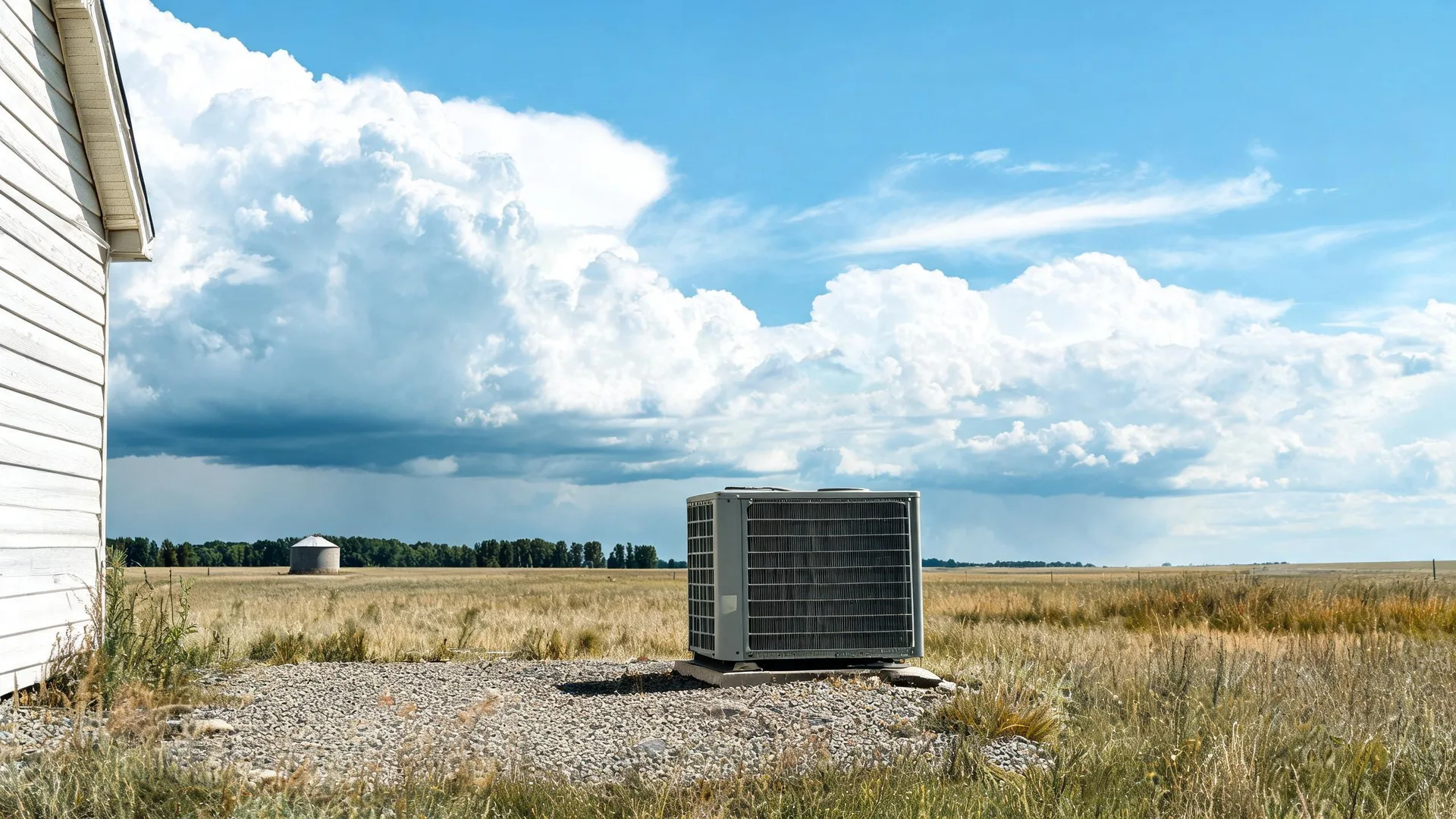
A gray outdoor HVAC unit mounted on a concrete pad beside a house with gray lap siding and a stone foundation.

It hasn't been running long, and it hasn't been running hard

Half the homes in Barrow County were built in 2001 or later, so a lot of what's heating them is newer too. If your system came with a house like that, the clock on it hasn't run far. Pair that with a climate that doesn't push a heat pump hard, and you've got a unit that's young and hasn't worked much for its age. That's a system worth putting a part into rather than replacing outright. Ask the technician who comes out how old the unit is and what shape the parts around it are in before you decide anything.

What a failing heat pump sounds and feels like

A heat pump in trouble usually tells you before it quits outright. Air coming from the vents that's cooler than normal in winter or warmer than normal in summer means it's struggling to move heat the way it should. Short cycling, where it kicks on and off every few minutes instead of running a full cycle, points to a sensor or a control board issue. Ice building up on the outdoor unit when it shouldn't be there, ongoing clicking or buzzing when it starts, or the outdoor fan not spinning while the unit is drawing power are all signs something specific has failed rather than the system just needing a filter change.

What to do once you notice something's off

Catching the sign early is what keeps a small repair from turning into a bigger one. A compressor that's working harder because of a low refrigerant charge will keep running that way until something downstream fails too, like the compressor itself. A dirty outdoor coil that's been ignored forces the whole system to run longer to do the same job, which wears everything else faster. The fix is almost never to wait and see if it gets better. Get a technician to look at the specific symptom, whether that's weak airflow, ice on the coil, or short cycling, and let them trace it to the part that's actually causing it.

A refrigerant leak is a good example of why running a struggling heat pump doesn't buy you time. A low charge makes the compressor work harder to move the same amount of heat, and heat it stays hot. Run it long enough in that state and you can take out the compressor itself, which is the most expensive part in the system. A dirty outdoor coil works the same way. Airflow drops, the system runs longer to hit the same temperature, and the extra runtime wears the fan motor and the compressor along with it. Ice on the coil is a sign to shut the system off and call, not to let it keep cycling, because ice blocks airflow further and the system just keeps digging the same hole. The part that failed first is almost always cheaper to fix than the part it takes down with it.

A technician weighing repair against replacement is really asking one question: is the damage contained to one part, or has the strain spread. A failed capacitor or a bad control board is an isolated failure. The rest of the system kept running fine around it, so replacing that one part brings the whole unit back to normal. A compressor that's been run too long on a low charge is a different story, because the compressor doesn't fail on its own, it fails from something else going wrong first and not getting caught. That's the real dividing line, not how old the unit looks or how many times it's been worked on. A system with one bad part and a maintenance history that shows it was looked after is almost always worth repairing. One that's been running compromised for a long stretch, where the failing part has already started taking others down with it, is the case where replacement gets talked about. A technician can tell you which situation you're in once they've traced the failure back to where it started.