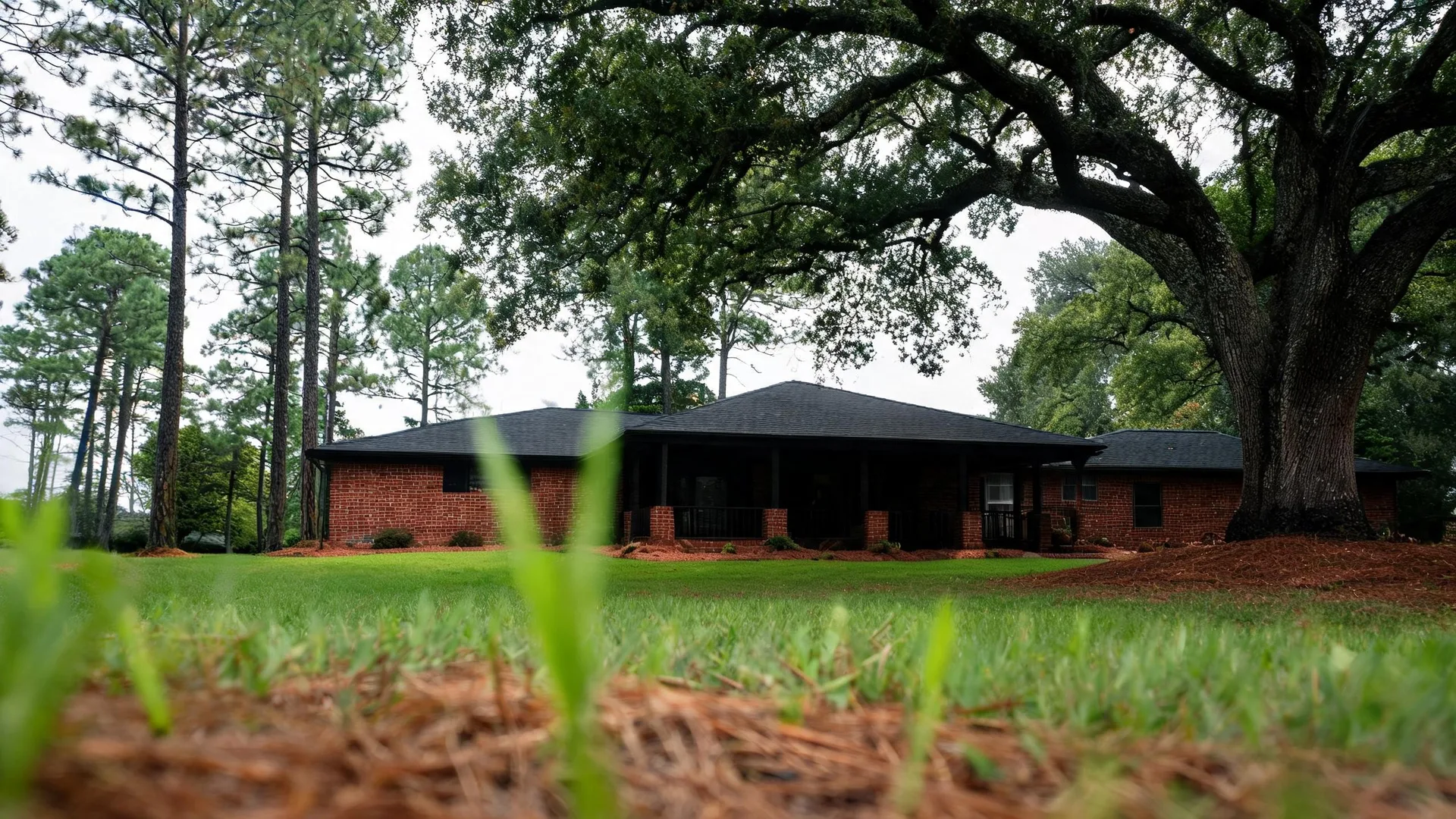
A single-story brick house with a dark hipped roof and covered porch, seen from a low angle across a lawn with blurred grass in the foreground, framed by pine trees and a large spreading oak on the right.

AC Maintenance in Cartersville, GA

Tell us about the job

Takes about a minute. No obligation.

Tune-up, service, or cleaningCentral ACBartow County, GA
Step 1 of 2

What ZIP code is the job in?

Electricity here runs 14.68 cents a kilowatt-hour

Bartow County homes paid an average of 14.68 cents per kilowatt-hour in 2025. A dirty coil or a low charge makes the compressor work harder to hit the same temperature, and every extra minute it runs gets billed at that rate.


A skipped tune-up shows up on the meter

A unit running clean and charged right cools your house with less effort than one that hasn't been looked at. The difference doesn't show up as a warning light. It shows up as a higher number on the bill each month the system runs.

5 months
May through September, your air conditioner is on duty
88°F
the average summer afternoon it cools against
12 hail events
in ten years, and hail bends the fins on outdoor coils
90 wind events
in ten years, and wind drives debris into outdoor units
Isometric cutaway illustration of a house with a dark shingled roof, showing interior ductwork connected to an indoor air handler and an outdoor condenser unit beside the building.
Your air conditioner works hardest from June through September.

NOAA nClimDiv, 1991–2020 normals

Five months of summer here, with afternoon highs averaging 88°F and air that sits heavy at a 67 degree dew point, asks a lot of a compressor.

A tune-up before May catches the worn part while it's still cheap to fix.

May is when it starts earning its keep here. Have it checked in April.

Cooling runs May through September
Climate zone 3A
Power here costs 14.68 cents per kilowatt-hour

May through September, the compressor doesn't get a break. That's five straight months of 88 degree afternoons pulling heat out of the house, day after day. A belt doesn't wear out here, because these units don't have one, but a capacitor does, and so does a contactor making and breaking that circuit thousands of times a season. Bartow County also sees its share of hard weather. Ninety damaging wind events hit the county between 2015 and 2024, enough to rattle an outdoor unit or knock debris into the coil. A spring check catches a weak part or a bent fin before the first real heat wave asks the whole system to prove itself.

A clean system costs less to run all summer

A tune-up now means the compressor runs clean before the bill reflects it. Get it checked before the heat sets in and let the savings run all summer instead of one less month of it.

Find a contractor
A man in a dark shirt and tan pants carries a waxed canvas tool bag up porch steps toward an orange front door, with a potted olive tree beside the entry.
An outdoor air conditioning condenser unit mounted on a concrete pad beside a house, with electrical conduit running to a wall-mounted disconnect box.

Your system is probably newer than you think. Keep it that way.

Half the homes in Bartow County were built in 1994 or later. If yours is one of them, the compressor and coil are likely still well inside their working life. A yearly check is what keeps it there. A tech can catch a refrigerant level drifting low or a capacitor starting to weaken long before either one costs you a compressor. Skip enough years of checks and a newer system starts racking up the same wear as an old one, just faster than it should.

The system rarely fails all at once

A capacitor weakens, the airflow across the coil drops, the refrigerant charge drifts a little low. None of that trips a breaker or throws a code. The unit keeps running, just worse, and the only sign is a house that takes longer to cool than it used to.

What a tune-up actually checks

A tech measures the refrigerant charge against what the system calls for, tests the capacitor and contactor under load, and washes out the coil so it can shed heat the way it's supposed to. Those are the parts that fail quietly, so they're the ones worth checking before the system has to prove itself.

Overhead view of an outdoor AC condenser unit on a concrete pad next to a house with a dark shingle roof.

Book your AC tune-up in April, before homes here start needing cooling in May.

  1. Jan
  2. Feb
  3. Mar
  4. Apr
  5. May
  6. Jun
  7. Jul
  8. Aug
  9. Sep
  10. Oct
  11. Nov
  12. Dec

A tune-up checks the refrigerant charge, cleans the coils, tests the capacitor and tightens the electrical connections.

A tune-up is a list of checks, not a once-over with a rag. The tech pulls the panel and checks the capacitor's output against what it's rated for, because a capacitor fades slowly and the compressor just struggles a little more each week until it finally doesn't start. The contactor gets a look too, since the contacts burn and pit from the arcing every time the compressor cycles on. Outside, the coil gets washed clean, because dirt and grass clippings packed into those fins make the whole system reject heat worse, and that makes the compressor run longer to do the same job. The refrigerant charge gets checked against the manufacturer's spec, not just topped off, since too much charge is as hard on a compressor as too little. Indoors, the blower wheel and the evaporator coil get checked for the same kind of buildup, because restricted airflow on that side makes the whole system work harder from the first minute it turns on.