






A gray outdoor heat pump unit with a circular fan grille sits on a concrete pad beside a dark wood-clad house, next to a gravel bed with ornamental grasses and a stepping-stone path.

One request and it's handed off

What size heat pump a Georgia home needs

Sizing a heat pump for a Georgia home comes down to your square footage, your ductwork, and how much sun your walls and windows take on, not a single number that works for every house. Get it wrong and you pay for it all year, in comfort or in bills. This page walks through how a contractor figures the right size for your home, and what to have ready when one looks at it. Send the form and the search for the right contractor is off your plate.

Let a pro reach out

There's no single number that fits every house. A heat pump sized right for your home depends on its square footage, its insulation, how many windows it has, and which way they face. A load calculation, usually a Manual J, is how an installer gets to the real figure instead of guessing. Go too big and the unit short cycles, cooling the air fast but leaving the muggy feel behind, then shutting off before it pulls out the moisture. Go too small and it runs flat out on the hottest days and still falls behind once winter asks it to carry your heat too, since most homes here use electric heat pumps for that as well. The right size costs less to run and holds the temperature steady in both seasons. The only way to know your number is to have your house measured, not guessed at from its square footage alone.

A gray outdoor condenser unit sits on a concrete pad beside a house with horizontal lap siding, with a wall-mounted disconnect box and refrigerant lines, mulched beds and a shrub nearby, and a concrete walkway in the foreground.
A heat pump sized to your home cycles on, runs long enough to pull the humidity down, and shuts off, in a steady rhythm you'd never notice.
An outdoor air conditioner condenser unit on a concrete pad beside a light gray vinyl-sided house, with an electrical disconnect box and conduit on the wall and bare soil in the foreground.
An oversized heat pump cools the air fast, shuts off before the humidity drops, and leaves the house feeling damp no matter what the thermostat says.
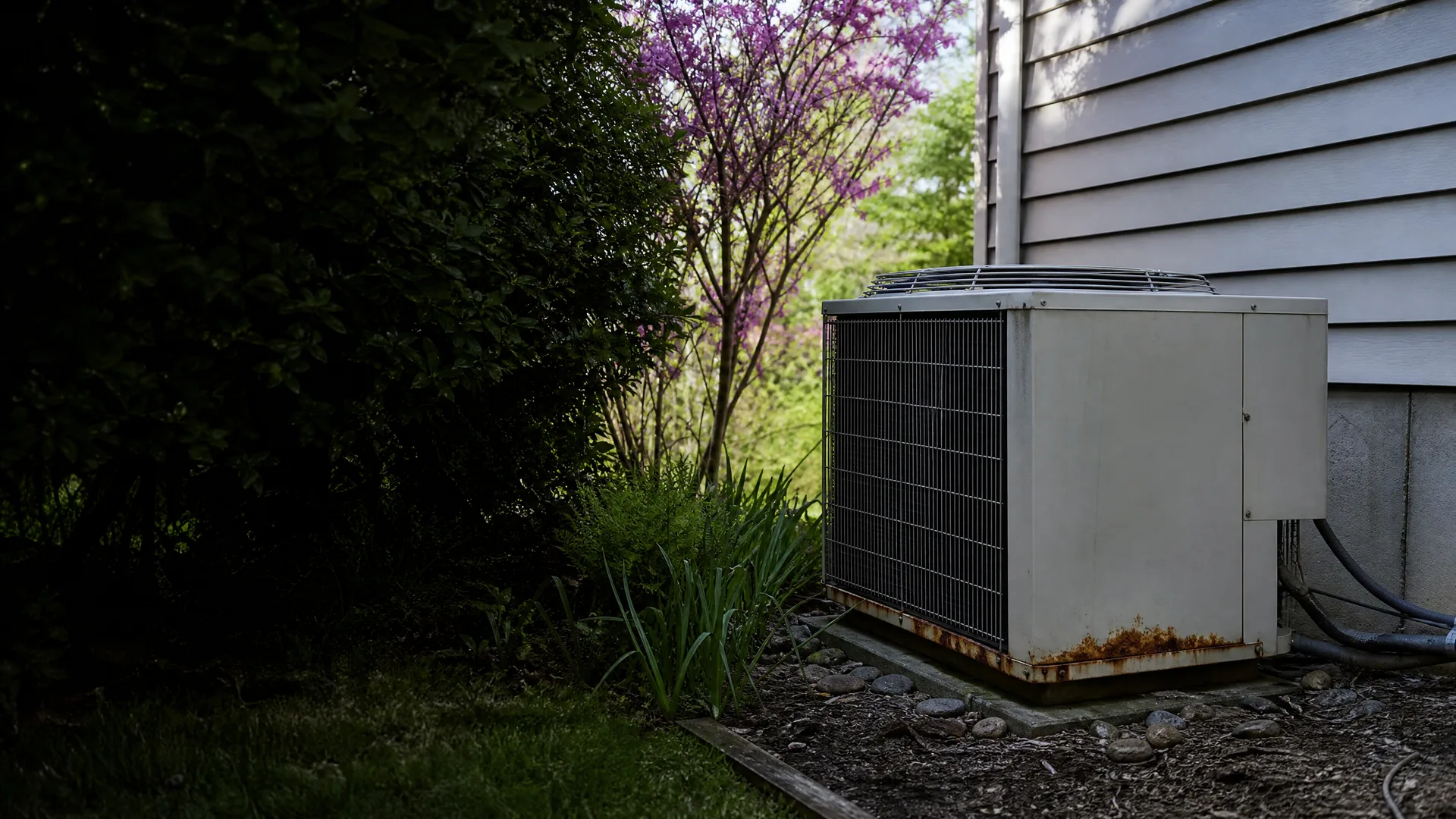
An outdoor air conditioning condenser unit with rust streaks sits on a concrete pad beside a light-colored lap-sided house, surrounded by shrubs, gravel and a flowering tree.

You walk around the side of the house to grab the hose and pass right by the unit. It's been sitting there since before you owned the place, rust creeping along the base where the metal meets the slab. The sun's out, mild for once, and you crouch down to look closer. The fins on one side are bent in, probably from a mower or a bad storm years back. You don't know how old it is. Nobody told you when you bought the house, and you never thought to ask. You think about the muggy months coming, how the place felt last August, and whether this thing out here is still sized for the house or just what came with it.

Undersized vs. Oversized

Undersized

  • It runs flat out on the hottest July afternoons and still can't hold the house at the thermostat setting.
  • The compressor rarely gets a break, which wears on the system over the years it's expected to last.
  • On the coldest nights it leans hard on backup electric heat strips, and that pulls more power than the heat pump itself.
  • It can keep up most of the year, then falls behind right when a heat wave or cold snap hits.
  • You notice rooms farthest from the unit staying warmer or colder than the rest of the house.

Oversized

  • It cools the house fast, then shuts off before it's run long enough to pull the humidity down.
  • Short cycles like that mean the compressor starts and stops more often, which adds wear over time.
  • Rooms can feel muggy even with the thermostat satisfied, because the air moved but the moisture stayed.
  • A bigger unit costs more to install than the size your house actually needs.
  • It can skip steadier, quieter operation for a pattern of blasting cold air and going idle.
A man in a navy sweater reclines in a leather armchair with his eyes closed and a slight smile, beside a side table with a mug and folded newspaper, in a room with a bookshelf and a sunlit window.
A bearded man in a navy robe over a gray shirt reclines with closed eyes in a brown leather armchair, with a houseplant, folded newspaper on a wooden table, and a bookshelf behind him.
A bearded man in a navy sweater reclines with closed eyes in a leather armchair beside a table holding a folded newspaper and a green mug, with a dresser, potted plants, a lamp and framed artwork behind him.
A man in a dark green sweatshirt reclines with his eyes closed and a slight smile in a brown leather armchair, with a window, table lamp, mug and newspaper beside him.

Done looking for a heat pump pro

Skip the round of in-home estimates for a new heat pump.

Sending the form costs nothing.

What a Manual J actually weighs

A Manual J doesn't start from your square footage and stop there. It adds up how much heat moves through your walls, your attic, your windows, and your ductwork, room by room, then checks that against how your house is oriented. A west-facing wall with three windows carries a bigger load than the same wall facing north. A house with ducts running through an unconditioned attic loses capacity before the air ever reaches a room. Two houses the same size, same year built, can come back with different numbers once an installer walks through them and measures what's actually there instead of guessing from the floor plan.

Why the right size runs longer

A correctly sized heat pump spends more time running than you'd expect, and that's the point. Short blasts of cold air cool a room fast but don't give the coil enough time to pull moisture out of it. A unit sized to the load runs in longer, steadier cycles, so the air moving across the coil has time to shed humidity before the thermostat is satisfied. That's what keeps a Georgia house from feeling damp at 72 degrees in July. The same sizing works the other direction too: in January, a heat pump matched to the house can keep up on electric heat without leaning on backup strip heat every cold morning.

An outdoor condenser unit sits on a concrete pad beside a house with horizontal vinyl siding, with a gray electrical disconnect box and conduit on the wall and a shrub at left.
Before you get your heat pump installation
A gray outdoor condenser unit on a concrete pad beside a light-colored horizontal-siding house, with a disconnect box and refrigerant line on the wall, ornamental grasses and a shrub in mulch nearby, and a concrete patio in the foreground.
After you get your heat pump installation

A new build on a slab

A house built in the last few years likely has better sealing and insulation than one from decades back, and that changes what size unit it needs. Two homes with the same square footage can call for different tonnage once an installer accounts for how tight the envelope is. A newer home often loses less heat through the walls and attic, so a Manual J may land on a smaller unit than you'd guess from square footage alone. Georgia's summer humidity still has to be pulled down either way, and that part doesn't change with age.


An older home with additions

A house that's been added onto over the years, a sunroom here, a converted garage there, often has ductwork that was never redesigned for the new layout. That makes sizing harder, since a Manual J has to account for rooms the original system wasn't built to serve. Insulation levels can vary room to room too, especially where an addition meets the original framing. An installer working on a home like this is weighing more variables than one on a single, unmodified footprint, and the right tonnage reflects that.

A gray-haired man with a beard in a blue button-placket shirt reclines on a couch with his eyes closed, beside a sunlit window with a green plant.
A woman in a cream knit sweater sits in an armchair with her eyes closed near a window showing yellow autumn foliage, with a mug on a round wooden side table beside her.
A single-story red brick building with a shingled hip roof, large windows and a recessed central entry, fronted by a wide empty asphalt parking area with sun glare, surrounded by green deciduous trees.

Georgia summers average a dew point of 68°F across June, July and August, according to NOAA climate data. That's heavy, sticky air, the kind that sits on your skin even in the shade. A heat pump sized right for your house has to pull that moisture out of the air, not just cool it down. If the unit is too big for your home, it chills the air fast and shuts off before the humidity drops, and you end up with a house that reads 72 on the thermostat but still feels damp. Getting the size right is what keeps that air feeling dry through August, not just cool.

NASA POWER T2MDEW county cells weighted by homes

A closed silver laptop and a glazed ceramic mug on a wooden table, with a blurred kitchen counter, potted plant, cutting board and window in the background.

The right size comes from your house, not a chart

A heat pump sized for your Georgia home holds the temperature you set and keeps the summer humidity down without running nonstop or short-cycling. That number comes from a Manual J, not a guess based on square footage alone. Get the load calculation right and the rest, the comfort and the bill, follows.

You could spend the next few weeks calling contractors, explaining your house and your old unit's model number over and over, and lining up quotes to see who actually ran the numbers instead of eyeballing it. Send the form instead and that work is off your plate. You'll have someone qualified to size your system without having to track them down yourself.

A wooden table holding a stone vase with a bare branch, two stacked books and a small dark bowl, beside a window with green foliage outside and a sofa in the dim background.
An outdoor air conditioning or heat pump condenser unit sits on a concrete pad surrounded by gravel beside a dark horizontal-sided house, with grass and shrubs nearby.

It's off your list after this

Describe the project once instead of to every installer.

New system or replacementHeat PumpGeorgia
Step 1 of 2

What ZIP code is the job in?