Profile view of a bearded man wearing a dark baseball cap and a dark gray T-shirt against a plain off-white background.

Why AC units freeze up in muggy Georgia summers

RepairCentral ACGeorgia
Step 1 of 2

What ZIP code is the job in?

Why does my AC unit keep freezing up in the summer?

You walk outside and find ice on the copper line or across the coil itself, usually on a day that's already hot and sticky. The air coming out of the vents has gone warm or stopped moving much at all. It's confusing because the unit is working harder than ever, not less, and that's exactly when it quits cooling the house.

Low airflow or low refrigerant is letting the coil get too cold

The coil needs a steady flow of warm air moving across it to stay above freezing. A dirty filter, a closed vent, or ductwork that's blocked cuts that airflow down, and the coil drops below 32 degrees and starts icing. A refrigerant leak does the same thing from a different angle: less refrigerant means lower pressure in the coil, and lower pressure means colder metal. Georgia summers make this worse because the air is so humid. Once ice forms, it holds moisture from that humid air and builds on itself, so a small problem turns into a solid block of ice fast. Once the coil ices over, no air gets through it at all, and the system needs to shut off and fully thaw before anyone can even tell what caused it.

An outdoor air conditioning condenser unit on a concrete pad beside a house with horizontal lap siding, with an electrical disconnect box and conduit on the wall and a green shrub to the right.

Running clean

Warm air crosses the coil, drops off its moisture, and leaves through the vents cold. The outdoor unit hums along, condensation drips from the pad, and the airflow at every register stays steady no matter how heavy the air outside gets.

An outdoor air conditioner condenser unit on a concrete pad beside a house with horizontal siding and a lower concrete foundation wall, with coiled refrigerant lines at right.

Iced over

Dirt and weather have caked the louvers and the fan grille, and airflow through the coil has dropped off. Once that happens, moisture on the coil can't evaporate fast enough and it freezes instead, which is what you're looking at here.

What are you seeing at your own unit right now

Go out and look at the copper line running into the outdoor unit. If it's sweating heavily or wrapped in ice, that's your answer forming. Inside, check the vents in whatever room feels off. Air that's barely moving, or air that's lost its chill, means the coil behind it is likely iced over and blocking the flow. You might hear the system running longer than usual, or notice water pooling near the indoor unit once the ice starts to melt. Left alone through a run of hot, muggy days, a frozen coil can push liquid refrigerant back into the compressor, and that's the part of the system that's expensive to replace.

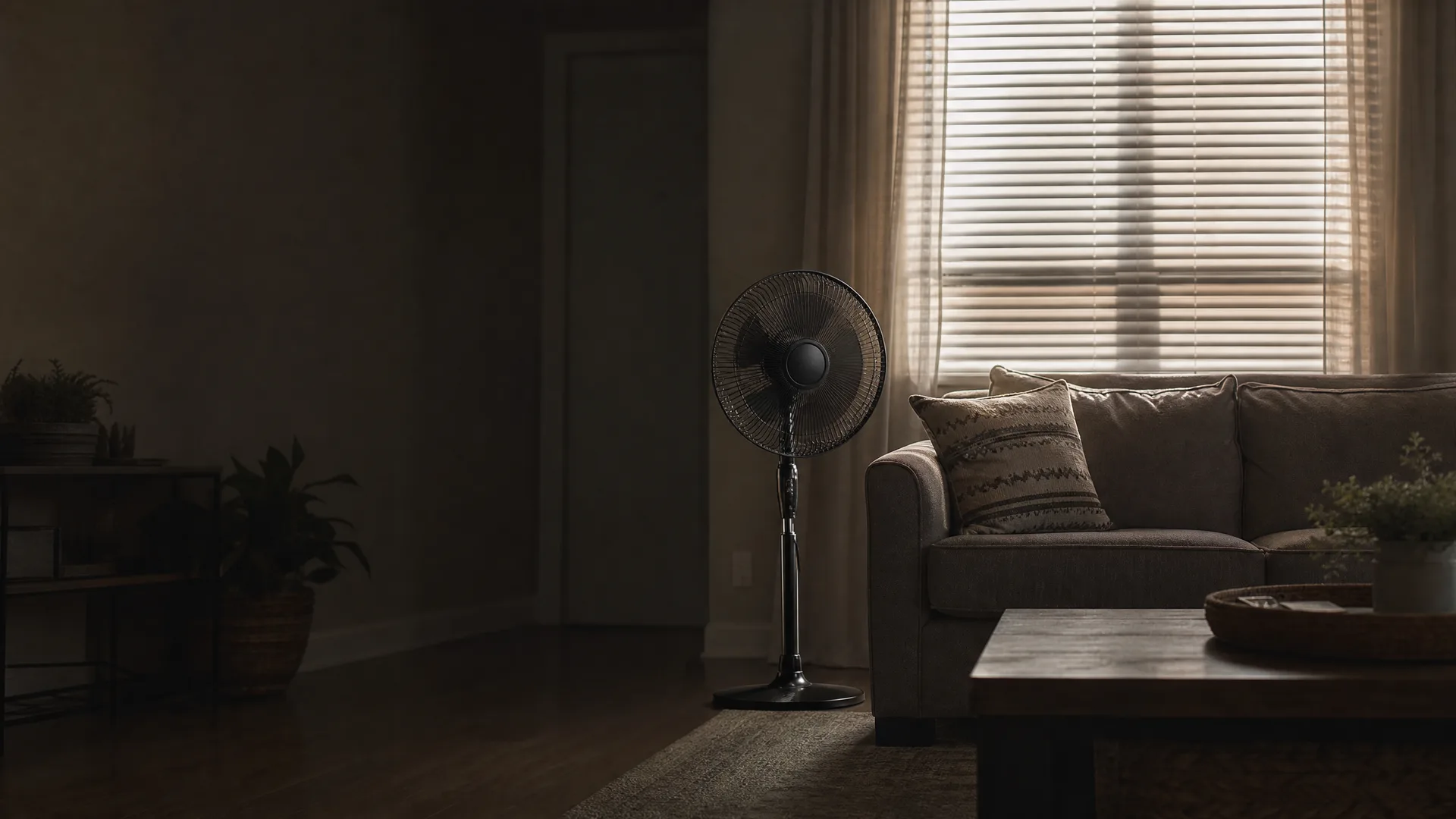
A dimly lit living room with a black pedestal fan on a wood floor beside a gray sofa with a patterned pillow, a wooden coffee table in the foreground, potted plants at left, and a curtained window with blinds behind.

It's a little past two in the afternoon and the blinds are drawn against the sun, the kind of July light that turns the gap at the edges white. The floor fan is running next to the couch, pointed at no one in particular, pushing around air that feels thick even inside. You've had a hand up at the vent twice now, waiting for the cold to hit your palm the way it should. It's there, barely, a thin breath of air that isn't doing much against a Georgia afternoon like this one. The fan keeps running because the vent isn't carrying its share anymore.


A wooden table in the foreground holds a closed laptop and a ceramic mug of coffee, with a spindle-back wooden chair behind it, a beige wall with paneled wainscoting, a window at left, and a kitchen counter with a cutting board, bowl of fruit and greenery at right.

What's actually happening inside that coil

Cold refrigerant runs through the indoor coil, and warm house air passes over the outside of it. In Georgia's thick summer air, that coil is pulling a lot of moisture out along with the heat, and that moisture has to drip away as condensate. If the coil surface drops below freezing, that moisture turns to frost instead of water. Low refrigerant charge does this because the coil runs colder than it should across its whole surface. A dirty filter or blocked return does it too, because starved airflow lets the coil chill down with nothing moving past it fast enough to keep it above freezing.

Once ice starts, it builds on itself. Frost blocks more airflow, less air flows across the coil, and the coil gets colder still. That's why the problem looks worse by the time you notice it than it was an hour before. Sorting out which cause you've got means checking charge with gauges and checking airflow through the system, not guessing from the ice itself. A contractor who works Georgia summers sees this pattern often enough to know where to look first, and one visit from someone licensed for your system beats spending an afternoon on the phone with different companies trying to describe ice on a coil to whoever answers.

Interior corner with sheer white curtains at a window, a brown upholstered sofa in the foreground, and a wooden multi-drawer cabinet holding a round ceramic vase with leafy branches.
A gray outdoor air conditioning condenser unit on a concrete pad beside a house with horizontal lap siding, with a wall-mounted electrical disconnect box and refrigerant lines, shrubs, mulch and lawn around it.

Working the way it should

The condenser sits on its pad, fins clean, lines running up to the disconnect box without a mark of ice anywhere on them. Air moves across those fins and heat leaves the house the way it's supposed to, no frost in sight even on the muggiest afternoon.

An outdoor air conditioner condenser unit on a concrete pad beside a house wall with stucco lower section, horizontal siding above, and a white downspout to the right.

Choked and freezing

This one's older, and the grime on the fins tells you airflow has been struggling for a while. Dirt packed into the coil keeps it running colder than it should, and once that happens ice builds on the lines instead of heat leaving through them.

A gray-haired bearded man in a dark knit sweater sits on a light gray sofa in a sunlit living room, looking to his left, with a framed artwork, a potted palm, and a curtained glass door behind him.
A middle-aged man in a dark green sweater sits on a light grey sofa looking toward a sunlit window, with a wooden shelving unit, lamp and potted plants in the background.
A man in a dark green sweater sits on a light grey sofa in a sunlit living room, looking to his left, with a shelving unit, houseplants, framed art and a large window behind him.
A gray-haired bearded man in a dark green sweater sits on a light gray sofa in a sunlit living room with a potted plant, framed picture, and dark shelving in the background.

Why low airflow freezes the coil

A coil only stays above freezing if enough warm air keeps moving across it. Cut that airflow back, with a clogged filter, a blocked return, or dust built up on the coil fins, and the refrigerant inside stays colder than it should for longer stretches. The coil surface drops below 32 degrees, and the moisture that thick Georgia air keeps throwing at it starts turning to ice instead of draining off as condensation. Once a little ice forms, it blocks more airflow and the problem builds on itself. That's why a unit can run fine for weeks and then ice over on the worst, muggiest afternoon, when it's working the hardest and has the least room for error.

Why low refrigerant does the same thing

A system low on refrigerant, usually from a leak somewhere in the lines, can't pull heat out of the coil the way it's sized to. The pressure inside drops, and the remaining refrigerant gets colder than it would running at the right charge. That colder coil freezes for the same reason a low-airflow coil does, except here the fix isn't a filter change. A technician has to find the leak, repair it, and recharge the system to the amount it's built for. Running a unit short on refrigerant for long stretches also puts more strain on the compressor, which is the most expensive part to replace.

A woman with shoulder-length dark brown hair in a cream knit cardigan sits in an upholstered armchair beside a window, looking off to the side, with a white bookshelf and potted plant blurred behind her.
A woman and a child wrapped together in a thick knitted blanket on a sofa, both with eyes closed, with a lit table lamp and houseplant in the dim background.

Skip calling around

The pro who reaches out is licensed in Georgia.

Sending the form costs nothing.

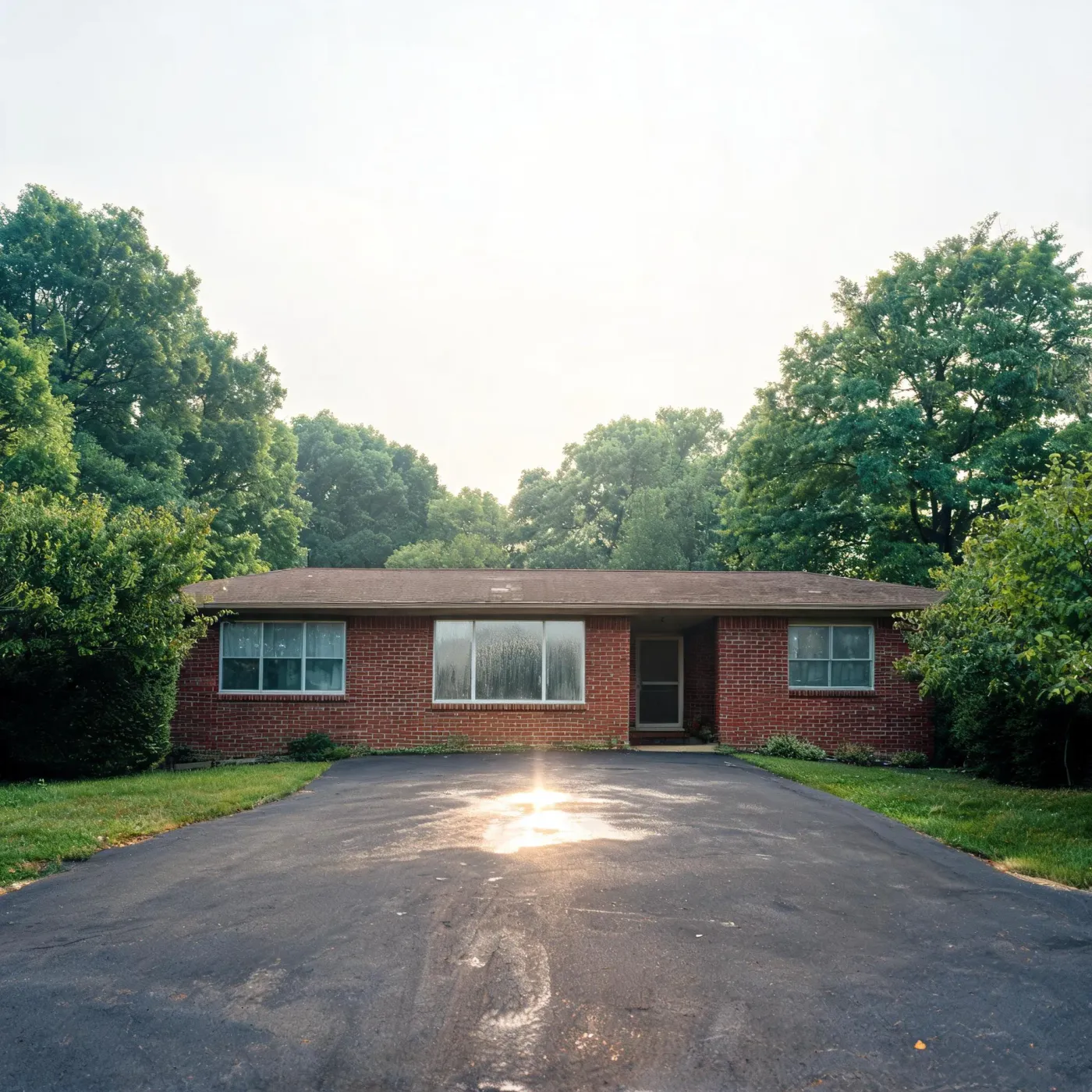
A single-story red brick ranch house with a low-pitched roof, large picture window and centered front door, fronted by a wide asphalt driveway and flanked by green deciduous trees and shrubs under a bright overcast sky.

A dew point of 68°F is the summer average for Georgia, measured by NOAA across June, July and August. That's thick air, heavy enough that your skin stays damp standing still. Your coil is the thing pulling that moisture out of the air before it ever reaches you, and at 68°F it's working on a load most coils elsewhere don't see. If airflow across it drops even a little, from a dirty filter or a blocked return, the extra moisture gives the coil more to freeze. That's the margin this weather leaves you, and it's thinner here than almost anywhere else.

NASA POWER T2MDEW county cells weighted by homes

Clear the Ice or Call It In

Call for repair

  • A licensed contractor can check the charge, measure airflow across the coil, and find which one caused the ice instead of guessing.
  • Someone local who works on Georgia units all summer has likely seen your exact symptom before and knows where to look first.
  • You explain the problem once, to one contractor, instead of calling around and repeating it to several companies.
  • A low charge means a leak somewhere in the line set, and that takes gauges and a trained eye to find and seal correctly.
  • Running the system with a frozen coil can push liquid refrigerant back into the compressor, which is a more expensive failure than the freeze itself.
  • One contractor means one visit and one diagnosis, not a stack of quotes to compare and sort through on your own.

Wait it out

  • Switching the system to fan-only can melt the ice off the coil, but it doesn't touch whatever caused the freeze in the first place.
  • A dirty filter or a closed vent is something you can fix yourself in a few minutes, no call needed.
  • If the ice came back after you cleared it, the cause is still there and will freeze the coil again the next hot, humid day.
  • Leaving a refrigerant leak unaddressed means the system keeps running low, which strains the compressor every time it cycles on.
  • Guessing at the cause without checking airflow, charge, and the coil itself means you might fix the wrong thing and lose a day of cooling for nothing.
An outdoor air conditioning condenser unit on a concrete pad beside a house with light vinyl siding, with electrical conduit running to a wall-mounted disconnect box and a shrub in mulch to the right.
Before you get your air conditioner repair
A gray outdoor air conditioning condenser unit on a composite pad beside a house with horizontal lap siding, with a wall-mounted disconnect box, refrigerant lines, and a wooden fence and shrubs to the left.
After you get your air conditioner repair

Before you get your air conditioner repair

You're watching the ice melt, running the fan to push air without cooling, maybe calling around to find someone who'll actually show up this week.

Find a local pro

After you get your air conditioner repair

A local contractor who knows Georgia units has checked the charge and the airflow, found what caused the ice, and fixed it.

Find a local pro

Power costs 14.74 cents per kilowatt-hour statewide

At 14.74 cents per kilowatt-hour, a frozen unit costs you twice. The fan keeps running while the compressor struggles against that ice, and you're paying for electricity that isn't cooling your house at all. Getting the freeze fixed stops that waste along with the warm air.

EIA-861 2025 statewide residential average

What a frozen coil comes down to

  • Ice on the line or coil means warm air isn't crossing it fast enough, usually from a dirty filter, blocked return, low airflow or low refrigerant.
  • Running the fan while ice sits on the coil doesn't fix anything and wastes power while the house stays warm.
  • The ice itself doesn't tell you which of those causes is behind it, only a contractor checking charge and airflow can find that.
  • A contractor who works on Georgia units all summer has likely already seen your exact symptom and knows where to look first.
  • One licensed, local contractor takes the call, so you're not fielding a round of quotes from companies you don't know.
  • Once the cause is found and fixed, the coil stays above freezing and the vents run cold again, even on the muggiest days.

A frozen coil has one cause behind it: not enough warm air crossing the coil, or not enough refrigerant inside it to begin with. That's true whether the ice showed up today or it's happened to you before. What's different is which one did it this time, a filter clogged enough to choke the airflow, a return that's blocked, or a charge that's run low. You can see the ice. You can't see which of those caused it, and running the system harder while it sits there iced over just adds to the power bill without moving you any closer to an answer.

Finding the actual cause is the job a licensed contractor does, checking airflow and charge rather than guessing from what the ice looks like. Georgia summers keep that kind of work steady for a contractor local to you, which means the unit outside your house is the same kind they've opened up plenty of times already this season. When you put in the request, it goes to one contractor, not a handful of companies chasing the same lead. That's one call to make and one visit to schedule, not a stack of quotes to sort through first.

Get the real cause fixed and the coil holds above freezing the way it should, air moving across it fast enough and refrigerant at the level it needs to be. The vents go back to running cold, even in August, even with the dew point sitting where it does most of the summer here.

Corner of a room with a white window at left, a white fireplace mantel with dark stone surround at right holding a weathered clay vase of leafy branches, and a cream upholstered sofa with a knit throw and tan pillow in the foreground.
A cushioned window seat with a brown lumbar pillow beside a white-framed window overlooking green trees, next to built-in cream cabinetry with shelves holding ceramic vessels and a wooden bowl.
An entryway with a dark wood console table holding a stone vase of olive branches and a shallow wooden bowl, a woven basket on the lower shelf, a framed landscape print on the wall, and a glass-paned wood door at left.
A wooden vanity cabinet with dark knobs and a beige stone countertop holding a round terracotta vase with leafy branches, beside a wood-framed mirror and a white sink.
Sunlit room corner with wide-plank oak flooring, white baseboard molding and beige walls, a window at left showing green trees, and a dark cabinet at right topped by a stone vase holding a leafy branch.

No phone calls to make

Your request stays with one local pro.

Get a licensed local pro

It costs nothing to send, and you don't have to hire anyone.