An outdoor air conditioning condenser unit positioned beside a blue-sided house at sunset.

AC Installation in Mableton, GA

Tell us about the job

Takes about a minute. No obligation.

New system or replacementCentral ACCobb County, GA
Step 1 of 2

What ZIP code is the job in?

Storms come through here regularly

Cobb County recorded 105 severe weather events between 2015 and 2024, including 70 cases of damaging wind, 22 hail events, and 4 tornadoes. Three tropical storms or hurricanes reached the county in that same stretch.

Power doesn't always hold through it

Close to a third of Georgia households were without power for a day or longer at some point in 2024. A new air conditioner sits outside through whatever weather and whatever outage comes with it, so where it goes and how it's protected are part of the installation, not an afterthought.

5 months
May through September, your air conditioner is on duty
88°F
the average summer afternoon it cools against
22 hail events
in ten years, and hail bends the fins on outdoor coils
13.4 SEER2
the federal minimum any new unit must meet
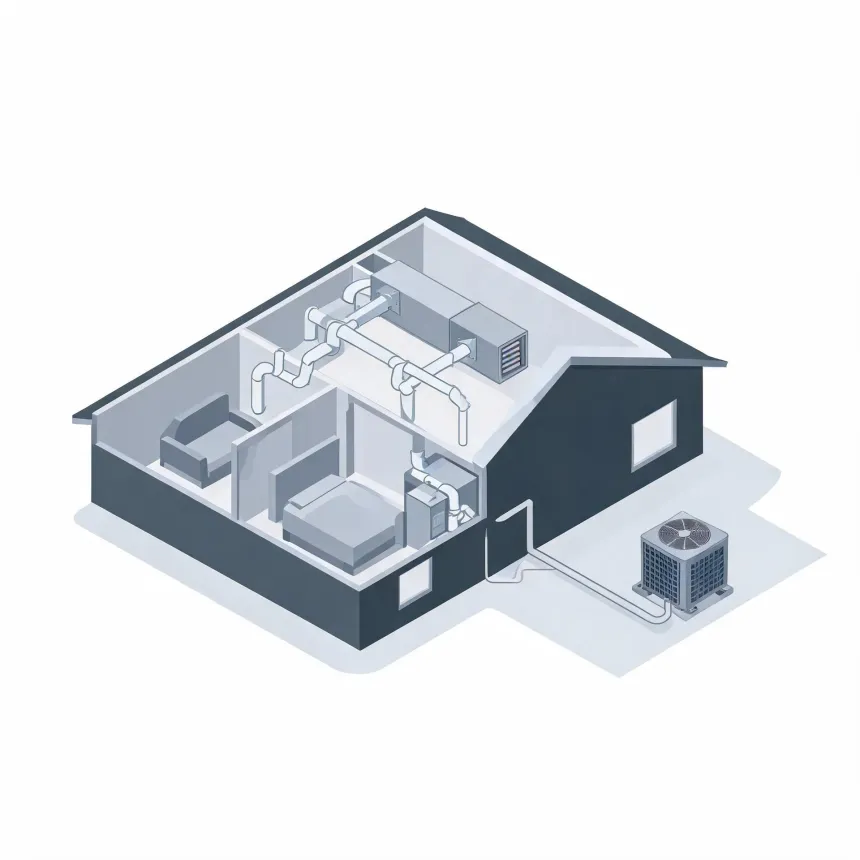
Isometric cutaway illustration of a house showing interior ductwork, an air handler and furnace unit, and an outdoor condenser connected by lines outside the wall.
Your air conditioner works hardest from June through September.

NOAA nClimDiv, 1991–2020 normals

Gas heats 68.2 percent of homes in Cobb County.

Most houses here already have the gas furnace half of the system, so the AC install is usually just the AC half.

Five months of cooling, one window to get it installed before it starts

Cooling runs May through September
Climate zone 3A
Power here costs 13.94 cents per kilowatt-hour

Cobb County falls under zone 3A in the 2021 energy code, warm and humid with a long cooling season. Any split-system air conditioner installed here has to meet 14.3 SEER2 if it's under 45,000 Btu/h, or 13.8 SEER2 at or above that. That's higher than the national minimum of 13.4, which only applies outside the Southeast. It narrows what a contractor can legally put in your house. A unit that meets the national minimum but not the regional one can't go in here, no matter what it's rated elsewhere.

Plan for where it sits and what happens when the power goes out

The spot the installer picks for the outdoor unit and the setup you choose for backup both matter here. Ask about mounting it away from debris and hail paths, and whether the system can be wired to a generator or battery before it goes in, not after.

Find a contractor
A man in a dark sweatshirt and tan work pants, seen from behind, climbs porch steps toward a red-orange door while carrying a worn canvas duffel bag.
A gray residential air conditioning condenser unit mounted on a concrete pad outdoors, surrounded by green grass under a partly cloudy blue sky.

The size is a calculation, not a guess

Sizing an air conditioner is a load calculation, not a swap of the old number for a new one. A contractor measures the square footage, but also the windows, the insulation, the ceiling height, which way the house faces, and how many people live there. Two houses the same size can need different tonnage. Get it wrong and the machine fights you both ways. Too big, and it cools the air fast but shuts off before it pulls the moisture out, so the house feels cold and damp at once. It also cycles on and off more than it should, and every start wears the compressor a little more. Too small, and it runs constantly trying to catch up, never quite reaching the thermostat setting on the hottest days, and the extra runtime wears parts out ahead of schedule. The right size runs long, steady cycles, enough to dehumidify properly, then rests. That balance is the whole point of the calculation, and it's worth asking the contractor to walk you through how they got the number rather than just handing you a quote.

The rating measures a season, not a moment

SEER2 is worked out over a whole cooling season, not on the hottest day of the year. A unit earns its rating by running efficiently across mild days and hot ones alike. On the single hottest afternoon, any air conditioner draws more power and works harder than its rating suggests, because that number is an average, not a ceiling.

A higher number changes the equipment, not just the bill

Reaching a higher SEER2 usually means a bigger condenser coil, a variable-speed or two-stage compressor instead of a single-speed one, and sometimes a variable-speed air handler to match. That changes how the system sounds, how it cycles, and what the installer needs to check, like airflow and refrigerant charge, to get it running the way the rating assumes it will.

An outdoor air conditioning condenser unit positioned on a concrete pad next to a blue-sided house, surrounded by green shrubs and flowering hydrangeas at sunset.

Going above the federal minimum saves little here, about $20 a year.

  • A higher-efficiency unit$320 a year
  • A new unit at the federal minimum, 14.3 SEER2$340 a year

Estimates for a typical Cobb County home, from EIA household energy data, Georgia fuel prices and NOAA climate normals. Your home will differ.

The price of an install comes down to what has to change, not just what goes in the backyard. If the ductwork already fits the new system, labor is straightforward. If the old ducts are undersized or leaky, they need work before the new unit can perform the way it's rated to, and that adds time on the job. The line set, the electrical disconnect, the pad the condenser sits on: all of it has to match the new equipment, not the old one, and whatever doesn't match gets replaced. A two-stage or variable-speed compressor costs more than a single-speed unit, and the thermostat and air handler have to be able to talk to it. None of this is optional or padded in. It's what makes the system actually run the way it's supposed to once it's in the ground.