





Single-story houses with beige siding and a brick building set on a mown lawn behind a trimmed hedge, framed by large oak branches draped with Spanish moss.

AC Installation in Monroe, GA

Tell us about the job

Takes about a minute. No obligation.

New system or replacementCentral ACWalton County, GA
Step 1 of 2

What ZIP code is the job in?

Walton County recorded 191 severe weather events between 2015 and 2024. Most of that was damaging wind, 176 events in that span, with 4 hail events, 3 tornadoes, and 6 tropical storms or hurricanes mixed in. An outdoor condenser sits outside through all of it, exposed to wind-blown debris and hail. When storms knock the power out here, it's not always a quick flicker. Statewide, 31% of households went at least 24 hours without power in 2024. A new AC system in this county is worth installing with that in mind, not just the heat.

5 months
May through September, your air conditioner is on duty
89°F
the average summer afternoon it cools against
4 hail events
in ten years, and hail bends the fins on outdoor coils
13.4 SEER2
the federal minimum any new unit must meet
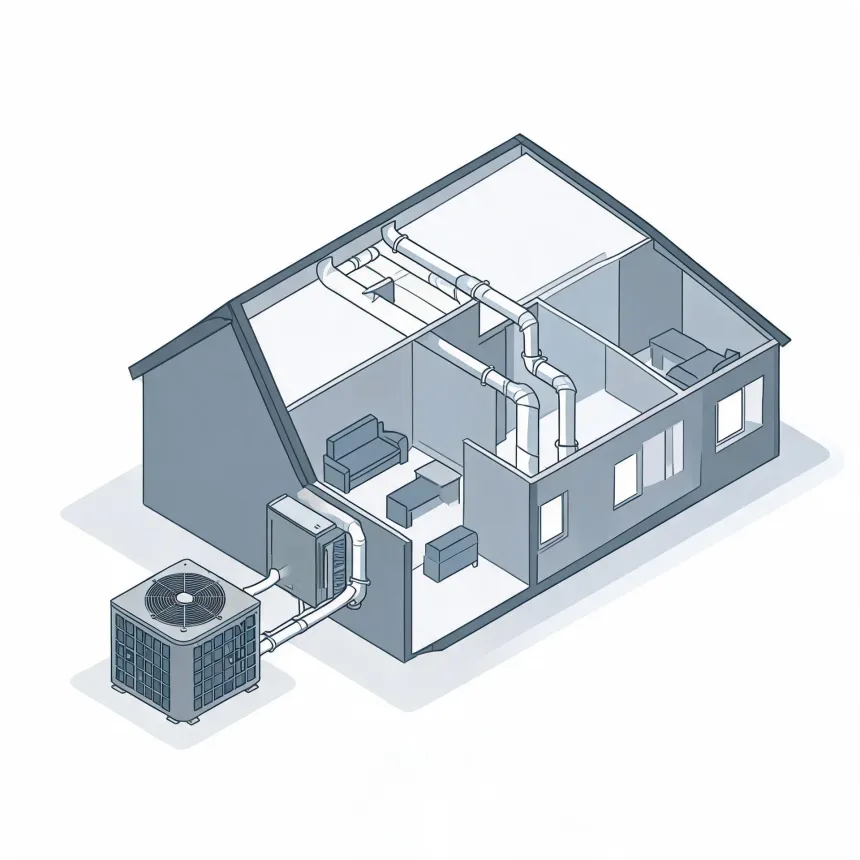
Isometric line illustration of a cutaway house showing interior rooms with ductwork, an indoor air handler, and an outdoor condenser unit connected by lines, on a white background.
Your air conditioner works hardest from June through September.

NOAA nClimDiv, 1991–2020 normals

Electricity here runs 13.96 cents per kilowatt-hour.

An efficient system costs less to run every month it's cooling this house.

Most homes near Monroe heat with electricity, and your AC install should plan for the same outages

68.4% of homes heat with electricity
Climate zone 3A
Power here costs 13.96 cents per kilowatt-hour
Have it in before MayCooling here runs May through September, so April is the month to get the new system in.

Cooling runs about five months here, May through September, and June through August the afternoon high averages 89°F with a dew point around 67°F. That dew point is high for the country, and it's what makes the air feel heavier than the temperature alone would suggest. A system sized for this county is working a long stretch at real load, not just a few hot weeks. That's on top of what the wind and the outages already covered do to it. Between the heat load and the weather exposure, this is not a system to size on a guess or buy on sticker price alone.

Plan the install around the outages, not just the heat

Where the new unit goes and how it's protected is worth deciding at install, not after a storm. An outdoor condenser exposed to wind-blown debris is a real risk, given 176 damaging wind events in this county between 2015 and 2024. Ask the contractor about a mount and a spot clear of falling limbs. Ask too about how the system handles a power cut, since 31% of Georgia households went at least 24 hours without power last year. Both are easier to plan for now than to fix later.

Find a contractor
A gray metal air conditioning condenser unit mounted on a concrete pad in a flat grassy field under a partly cloudy sky.

Five months a year, in weather that tests it

Five months of real load, May through September, is what the new system signs up for here. The county saw 176 damaging wind events between 2015 and 2024, and 6 tropical storms or hurricanes in that same stretch. A condenser running that long, sitting outside through that much weather, earns its keep or it doesn't. Install quality decides which. A unit mounted right, charged right, sized for this load, holds up to that stretch of summers. One rushed in to save a day wears into it faster, and the part that gives out first is usually the one you notice on the hottest afternoon of the year.

Ask what happens when the power comes back on

A compressor needs a few minutes of rest between stopping and starting again, or it strains against pressure that hasn't equalized yet. Some systems have a built-in delay that handles this on their own. Others rely on a separate control to do it. Ask which one you're getting, and whether that protection comes standard or gets added on.

Ask what the warranty actually covers after a storm

Most manufacturer warranties cover parts that fail from normal wear, not damage from a falling limb or wind-blown debris. That kind of damage falls under homeowner's insurance instead, and only if the unit was installed and maintained the way the manufacturer specifies. Ask the contractor to show you in writing what voids the warranty, so you know before anything happens, not after.

An overhead view of a residential air conditioning condenser unit mounted on a concrete pad next to a house with vinyl siding.

Going above the federal minimum saves little here, about $20 a year.

  • A higher-efficiency unit$320 a year
  • A new unit at the federal minimum, 14.3 SEER2$340 a year

Estimates for a typical Walton County home, from EIA household energy data, Georgia fuel prices and NOAA climate normals. Your home will differ.

A straight install starts with sizing, not the equipment catalog. The contractor runs a load calculation on the house, the windows, the insulation, the ductwork, and picks a unit that matches it, because oversized or undersized both end in a system that runs wrong. The old equipment comes out first, the line set and pad included, and the ductwork gets checked while it's open since a new condenser pushing air through bad ducts never performs the way the rating sheet says it should. The new condenser gets set and leveled on its pad, the lines get run and connected, and the system gets evacuated to pull moisture and air out of the lines before any refrigerant goes in. Charging it right matters as much as anything else that day, because a system that's over or under charged wears its compressor down long before it should. Once it's running, the contractor checks static pressure, temperature split across the coil, and airflow at the vents, not just whether cold air is coming out.