A nighttime street scene featuring a row of lit white colonial-style houses with wrap-around porches, flanked by oak trees draped in Spanish moss.

Mini Split Installation in Newnan, GA

Tell us about the job

Takes about a minute. No obligation.

New system or replacementMini-splitCoweta County, GA
Step 1 of 2

What ZIP code is the job in?

Storms come through Coweta County often

Weather data shows 221 severe weather events in Coweta County between 2015 and 2024, including 174 damaging wind events, 29 hail events, and 9 tornadoes. Six tropical storms or hurricanes reached the county in that same stretch.

Power doesn't always hold through it

Nearly a third of Georgia households went at least a day without power in 2024. A mini split's outdoor unit sits exposed to wind and hail, and when the power drops, so does your heat or hot water until it's back.

5 months
November through March, your system heats
5 months
May through September, it cools
35°F
the average winter night it heats against
88°F
the average summer afternoon it cools against
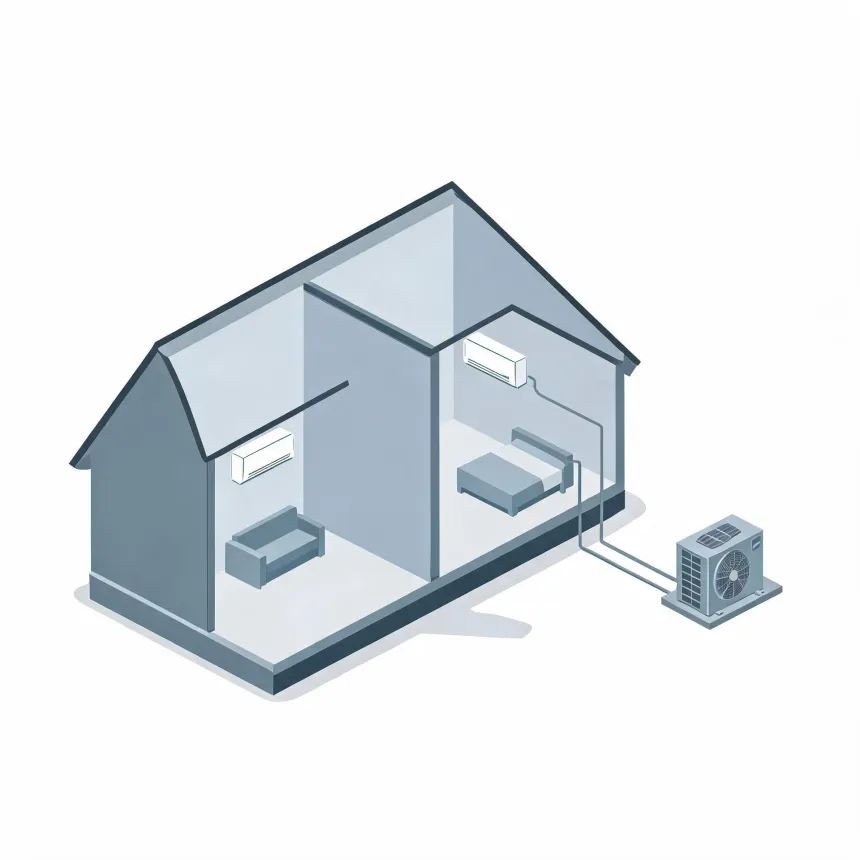
Isometric grey illustration of a cutaway house showing two rooms with wall-mounted indoor air conditioning units connected by lines to an outdoor condenser unit beside the building.
Your system heats November through March and cools May through September.

NOAA nClimDiv, 1991–2020 normals

Cooling season in Coweta County starts in May.

April is the month to get a mini-split installed, before the heat and the storms it brings arrive.

Most homes here run on electricity, and your mini-split will too

51.4% of homes heat with electricity
Cooling runs May through September
Summer afternoons average 88°F

Electricity in Coweta County runs 14.12 cents per kilowatt-hour on average. A mini split earns its keep against that rate because of how it moves heat instead of making it. It runs for cooling all summer and for heat all winter, so efficiency counts twice over the year. The rating to check is SEER2 for cooling and HSPF2 for heat, and a higher number there means less pull on the meter for the same comfort. Since most homes here already run on electricity, that rate applies to the mini split the same as everything else plugged in.

Plan for the outage before the install is finished

Installation is the time to decide where the outdoor unit sits and how it's mounted, before a contractor pours the pad or runs the line set. Ask about a surge protector for the system too, and whether the indoor head can run off a battery or small generator when the power drops. Getting that settled now means less to work out when a storm actually comes through.

Find a contractor
A white outdoor air conditioner condenser unit mounted on metal wall brackets against gray horizontal siding, with a blue sky and white clouds behind it.

Five months of summer, and weather the rest of the year

The mini split will run cooling from May through September, five months of the year, and the afternoon high averages 88°F through June, July and August. That's the stretch where the outdoor unit works hardest, pulling heat out of air that's already hot and heavy. Wind doesn't care what season it is. Coweta County saw damaging wind 174 times between 2015 and 2024, close to one event every three weeks, and that unit sits outside through all of it. A system sized right for this load holds up better than one picked just because it was cheaper up front.

Ask what happens in a head's worth of zones

A mini split can run one indoor head or several off the same outdoor unit. More heads pull on the same compressor, so ask how the system is sized to keep every room comfortable at once, not just the one nearest the thermostat. A system sized for one zone won't quietly stretch to cover three.

Ask how the line set and drain are run

The refrigerant lines and condensate drain have to get from the outdoor unit to each indoor head, usually through a wall sleeve. Ask where that penetration goes, how the lines are insulated, and where the condensate drains to. A poorly sloped drain line backs up and shuts the system down, long after the install crew is gone.

Sizing a mini split starts with a load calculation, not the square footage of the room. A contractor works through the walls, the windows, the insulation, and how much sun a space gets, because all of that changes how much heat moves in or out. Too big and the system short cycles, running in quick bursts that cool the air but never pull the humidity down, so the room feels clammy even at the set temperature. Too small and it runs flat out without ever catching up on the hottest or coldest days, which wears on the compressor. The same math applies on the heating side, since the same unit that cools in summer is what's keeping rooms warm in winter. Getting the number right matters more with a mini split than with a central system, because there's no ductwork to even out a sizing mistake across the house.

Coweta County falls in climate zone 3A, and that zone sets a floor on efficiency, not a ceiling. A mini split counts as a split-system heat pump under the federal standard, so any unit built from 2023 onward has to pull at least 14.3 Btu of cooling for every watt-hour it uses, and deliver at least 7.5 Btu of heat the same way. That's not a target a contractor aims for. It's the minimum the equipment has to clear before it can be sold and installed here. A system that meets it also tends to qualify for the federal tax credit on heat pumps, worth checking against before you settle on a model. Ask to see the SEER2 and HSPF2 numbers on the spec sheet, not just a brand name.