Electricity here runs 15.79 cents a kilowatt-hour
That rate applies to every kilowatt a mini-split draws, through a long cooling season and a cold one. A unit that runs often here puts that rate to work every day it's on.
Takes about a minute. No obligation.
That rate applies to every kilowatt a mini-split draws, through a long cooling season and a cold one. A unit that runs often here puts that rate to work every day it's on.
A mini-split sized and installed right for this house uses less power to do the same job. The difference shows up on the electric bill, not on a spec sheet.
NOAA nClimDiv, 1991–2020 normals
Cooling runs May through September here, five months straight once it starts.
Get the install done before May and the system is ready on day one, not fighting its first heat wave.



DeKalb County saw 165 severe weather events between 2015 and 2024, and 132 of those were damaging wind. An outdoor condenser sits outside through all of it, exposed to wind-driven branches and whatever hail comes through, and this county has had 14 hail events in that same stretch. Where the installer places that unit and what they mount it on matters more here than in a calmer county. Power loss is the other side of it. Statewide, 31% of Georgia households lost power for a day or more in 2024, and when that happens a mini-split goes with it. If this system is covering cooling or backing up heat, it's worth asking what happens to that during an outage, and whether a generator connection makes sense for this house.
The rate on your electric bill is fixed. What changes it is how the system was sized and installed. Get that right at the start and every kilowatt this mini-split draws over a long cooling season buys you less on the bill.
Find a contractor
Five months of cooling here is already more than most of the country runs. An afternoon in June, July or August averages 88°F, and the dew point averages 67°F those same months, higher than most US counties see. Air that heavy makes a mini-split pull moisture as well as heat out of a room, which is more work than just cooling dry air. Run that kind of load five months straight and the compressor and coil see more hours than they would in a milder place. A system sized right for this house carries that load without strain. One sized wrong starts showing it early, in a coil that cannot keep up or a bill that climbs.
A mini-split is sized by working out how much heat a room gains and loses, counting the windows, the insulation, the ceiling height and which way the room faces. Square footage alone skips all of that. Two rooms the same size can need different size units depending on sun exposure and what is on the other side of the walls.
An oversized unit cools the air fast and shuts off before it pulls the moisture out, so the room feels clammy even at the right temperature. An undersized one runs constantly and still cannot catch up on the hottest days. Either way the compressor cycles more than it should, and that shortens its life.
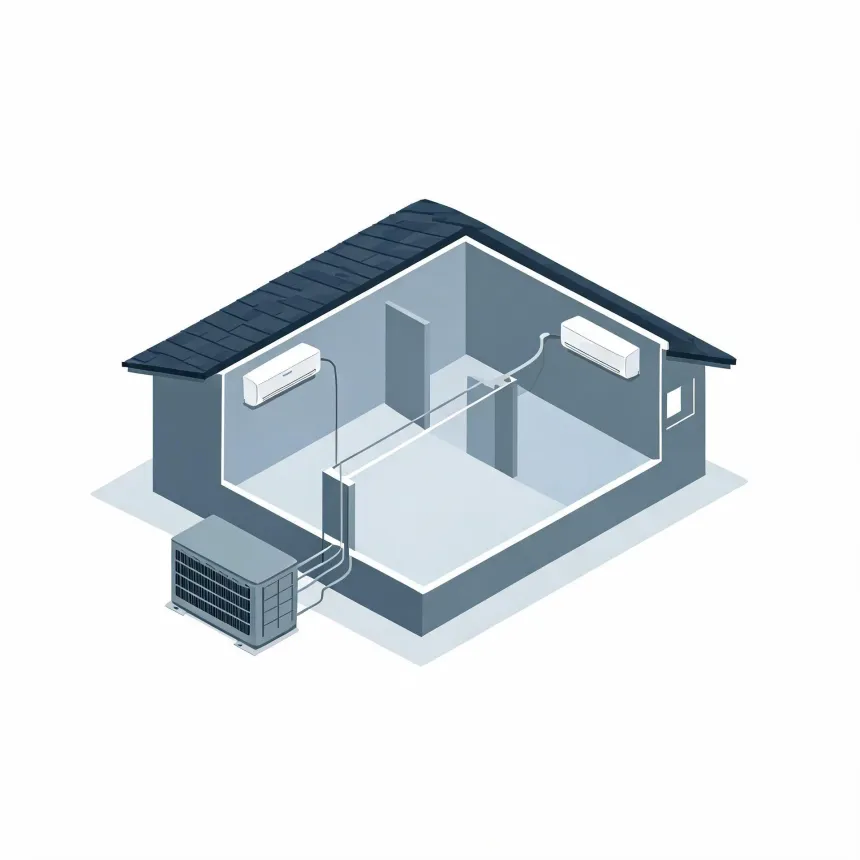
The price of a mini-split install comes down to what the installer has to do to get refrigerant moving correctly between the indoor and outdoor unit, and how much work the space demands beyond hanging two boxes. Line sets have to be cut to length, run through a wall, and connected with flared fittings that have to seal perfectly, since any leak there bleeds refrigerant out over time and kills efficiency long before the compressor fails. Longer line runs, more bends, and extra indoor heads all add labor and material. The electrical side matters too: a dedicated circuit sized to the unit, run from the panel, is part of the job, not an extra. Mounting the outdoor condenser on a stable pad or bracket, away from anything that blocks airflow across the coil, takes time to get right and pays off in how long that unit lasts. None of this shows up on a price tag until someone has actually looked at the walls, the panel, and where the heads need to go.
DeKalb County falls in climate zone 3A under the current energy code, a warm zone with a long, humid cooling season and a short, mild winter. Any mini-split installed here, if it was manufactured on or after January 1, 2023, has to meet the federal minimum for that kind of system: at least 14.3 Btu of cooling for every watt-hour it draws, and at least 7.5 Btu of heat the same way. That floor applies whether the house needs a single small head or several. It does not set a separate rule for ductless systems. It narrows what an installer can legally put on the wall or the pad outside, and it sets the baseline every unit sold here has to clear before efficiency becomes a question of which model to choose.