Gas is the baseline here
Half the homes in Rockdale County heat with utility gas, and most of the rest run on electricity. Gas furnaces paired with central air are the setup a lot of contractors in this area already know well.
Takes about a minute. No obligation.
Half the homes in Rockdale County heat with utility gas, and most of the rest run on electricity. Gas furnaces paired with central air are the setup a lot of contractors in this area already know well.
If you're adding a mini split, you're not replacing a furnace. You're putting in ductless heating and cooling for a room or area the main system does not reach well, or stepping away from ducted equipment altogether in that space.
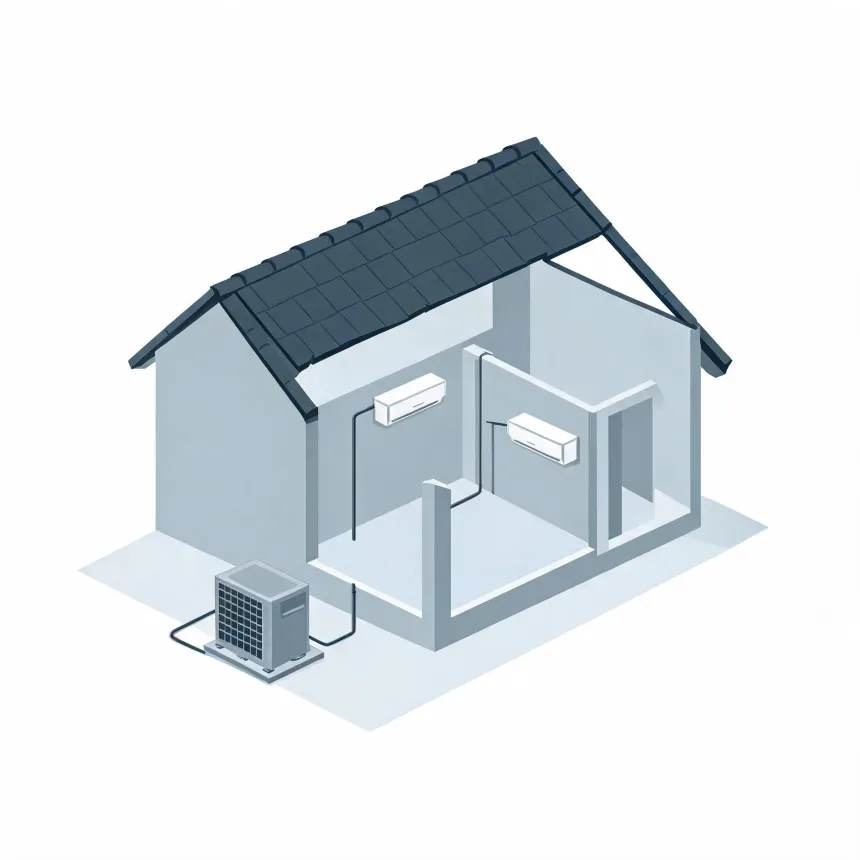
NOAA nClimDiv, 1991–2020 normals
Summers in Conyers run long, cooling from May clear through September.
A mini split sized for a mild climate will struggle here. Size it for a Conyers summer, not an average one.



Conyers sits in climate zone 3A, warm with mild winters and summers that run long. Any mini split installed here has to meet the federal minimum for a split-system heat pump. That means 14.3 SEER2 for cooling and 7.5 HSPF2 for heating. The rule applies whether the unit is ducted or ductless. The standard treats a mini split as a split system and sets no separate class for it. Those numbers are the floor, not a target. A unit built to just clear that line will run harder through a Conyers summer than one sized with months of heat in mind.
Rockdale County sees its share of damaging wind and the occasional outage. A standard mini split handles that fine. Nothing about the weather here calls for a bigger unit or a higher-end one than the job needs. Size it right for a Conyers summer and let the install happen before the heat does.
Find a contractorFive months of cooling a year, with afternoon highs averaging 89 through June, July and August. That's the stretch this unit has to answer to every summer it's in the wall. A standard mini split can handle that load, but only if it was sized for a Conyers summer in the first place. One picked off a mild-climate chart will run longer hours on those afternoons than it was built for. Have the contractor size against this stretch of summer, not an average one, before the unit goes in.
SEER2 and HSPF2 come from tests run under set conditions in a lab. They tell you how the unit performs under those conditions, not how it will perform on the hottest afternoon of the year or the coldest night. A unit can carry a strong rating and still struggle in a room it was never sized for.
A high rating on paper does not make up for a unit sized wrong for the space, a line set that runs too long, or an outdoor unit placed somewhere it can't breathe. The rating describes the equipment. How well it actually heats and cools the room depends on the contractor matching that equipment to the job in front of them.
Sizing a mini split starts with a load calculation, not a guess based on room size. A contractor measures the space, checks the windows, the insulation, and how much sun the room gets, then works out how much heat that room gains in summer and loses in winter. Too big and the unit short cycles, kicking on and off before it ever pulls the moisture out of the air, leaving the room cold and damp. Too small and it runs constantly on the hardest days and still can't keep up. Either mistake shortens the life of the compressor. The size written on the box is a starting point. What matters is whether it matches the room it's going into.
Once sizing is settled, the next questions are about how the system gets built out, because a mini split is more than the box on the wall. Ask how many zones the contractor is proposing and why. Each indoor head needs its own run of refrigerant line set and its own control, and more zones means more places for a line set to kink or a connection to leak if the work is rushed. Ask where the outdoor unit will sit and what's around it. It needs clear air on all sides to reject heat, and one pushed into a tight corner or boxed in by fencing will work harder than it should. Ask what happens to the line set between indoor and outdoor units, whether it runs through conditioned space or an attic, and how it gets insulated and sealed where it passes through the wall. A clean install hides most of this. A poor one shows up later as ice on the line set or a head that never quite keeps up.