A red brick wall with a row of low shrubs and mulch bed on the left, a mown lawn in the center, and a single-story light-colored house with a gabled roof beyond, backed by pine trees under an overcast sky.

Mini Split Installation in Cumming, GA

Tell us about the job

Takes about a minute. No obligation.

New system or replacementMini-splitForsyth County, GA
Step 1 of 2

What ZIP code is the job in?

Forsyth County sees real storm activity

Forsyth County recorded 76 severe weather events between 2015 and 2024, including 48 damaging wind events, 14 hail events, and 2 tornadoes. Hurricanes and tropical storms reached the county 3 times in that span, and winter storms hit 5 times.

Power doesn't always hold through it

Nearly a third of Georgia households went at least 24 hours without power in 2024. A mini-split only heats and cools while it has power, and an outdoor unit sitting through wind and hail needs to be placed and protected with that in mind.

7 months
October through April, your system heats
5 months
May through September, it cools
33°F
the average winter night it heats against
86°F
the average summer afternoon it cools against
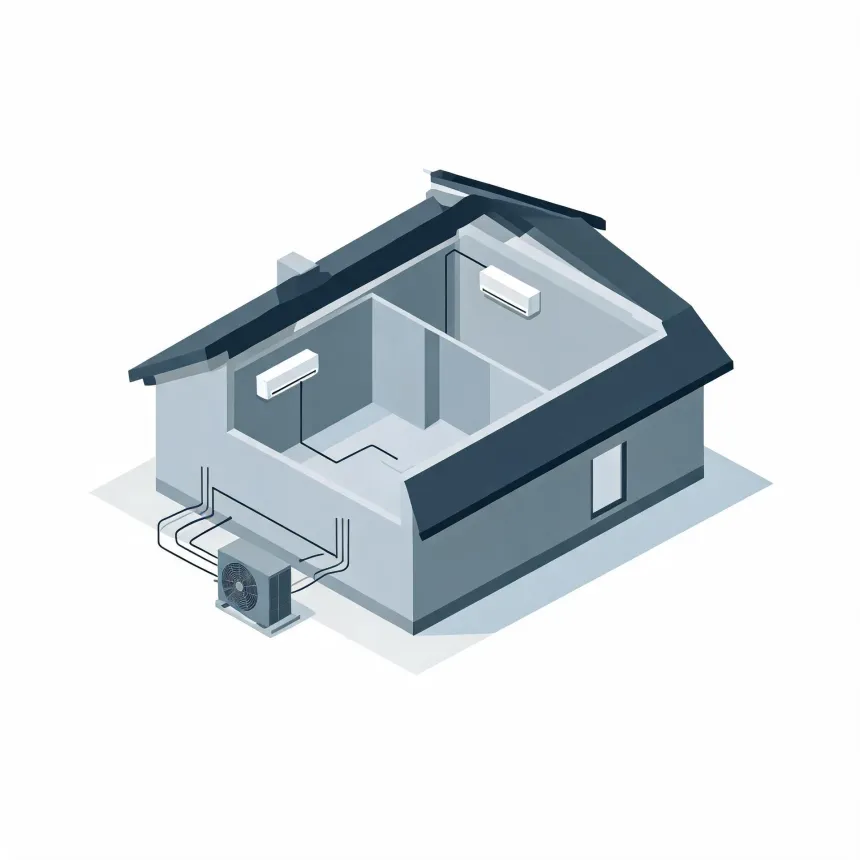
Isometric illustration of a cutaway house showing two wall-mounted indoor air conditioning units connected by line sets to an outdoor condenser unit on the ground outside.
Your system heats October through April and cools May through September.

NOAA nClimDiv, 1991–2020 normals

The number of indoor heads and the length of line hidden in the walls sets most of the labor.

A single zone is a day's work for a crew. Add heads, add a condenser, and the job stretches.

Five months of cooling a year, with time to get it done before May

Cooling runs May through September
Summer afternoons average 86°F
Power here costs 14.30 cents per kilowatt-hour
Most homes here run on gas heatGas heats 68.7 percent of homes in Forsyth County, so a mini-split usually joins a gas furnace instead of replacing it

Forsyth County sits in climate zone 3A, warm with a long cooling season and humidity that sticks around most of the year. Any mini-split installed here has to meet the federal minimum built for that load: at least 14.3 Btu of cooling for every watt-hour it draws over the summer, and at least 7.5 Btu of heating for every watt-hour over the winter. That rule applies to a ductless system the same as any other split system. There's no separate category for ductless. The standard covers units manufactured on or after January 1, 2023, so a system built earlier may not clear it. A federal tax credit is also available on a qualifying heat pump, worth looking into before the job gets scheduled.

Place it to survive the weather it will actually see

Plan the outdoor unit's spot before the crew shows up: clear of roof runoff, away from where hail and debris collect, with room for a cover if wind is a regular problem here. Ask what happens to heat and hot water if the power goes out, and whether the install can work with a generator or battery backup. A mini-split placed and wired with that in mind holds up better than one installed without it.

Find a contractor
A man in a dark sweatshirt and tan work pants, seen from behind, climbs porch steps toward a red-orange door while carrying a worn canvas duffel bag.
A white outdoor air conditioner condenser unit mounted on metal wall brackets against gray horizontal siding, with a blue sky and white clouds behind it.

The label tells you what it costs to run, not what it costs to buy

That SEER2 and HSPF2 number on the label is a ratio, cooling or heating output against the electricity it takes to produce it. A higher number means the compressor is getting more out of each watt, not that the unit is bigger or stronger. Two mini-splits can heat the same room, and the one with the higher rating does it on less power, every hour it runs. Over a system that's going to cycle on and off for years, that difference compounds. It also only holds if the system is sized right for the space and the line set is run clean, because a unit working harder than it should burns past whatever the label promised.

The old equipment doesn't just get unplugged

A window unit or an old ductless system needs its refrigerant recovered before anyone disconnects it. That refrigerant can't be vented to the air, so a tech pulls it into a tank with a recovery machine first. Only after that is the line set disconnected and the old equipment freed up to come out.

The wall usually keeps a scar

The old line set ran through a hole in the wall or the roof line, and the new install may not use that exact spot. Whatever opening gets left behind needs sealing against weather and pests, and the old mounting bracket or pad for the outdoor unit either gets reused or pulled and patched.

Comparing mini-splits comes down to a handful of straight questions, not brochure claims. Ask what the rated capacity is at the outdoor temperatures the system will actually face, not just at a mild test condition, because heat pump output drops as it gets colder outside and a unit that looks strong on paper can fall short on a hard night. Ask how many indoor heads the outdoor condenser is rated to run at once, and whether adding a zone later means a new condenser or just a new head on the existing line. Ask about the sound rating for the indoor head and the outdoor unit both, since that number varies more between models than people expect. Ask what the warranty actually covers, parts versus labor, and whether it stays valid only if a licensed tech handles the install and the startup charge. Ask who commissions the system once it's in, because a mini-split that isn't charged and tested properly at startup will never hit the numbers on its spec sheet.

Install day starts with two crews working at once, one inside and one out, because the indoor head and the outdoor condenser go up in parallel before the line set ties them together. The indoor head gets mounted high on a wall or ceiling, level, with a clear path back to where the line set will exit. Outside, the condenser sits on a pad or wall bracket, away from anything that blocks airflow across its coil. Once both are set, the tech drills the line set path, runs the refrigerant lines, the condensate drain and the electrical whip together, and seals the wall penetration against weather. The lines get connected, then the system gets evacuated with a vacuum pump to pull out moisture and air before any refrigerant moves, because trapped moisture turns to acid inside the line over time. Only after that does the tech open the valves, charge the system if needed, and run it through a startup check, verifying temperatures and pressures before calling the job done.