Weather here does damage
Hall County recorded 106 severe weather events between 2015 and 2024. That includes 78 damaging wind events, 8 hail events, 3 tornadoes and 6 tropical storms or hurricanes.
Takes about a minute. No obligation.
Hall County recorded 106 severe weather events between 2015 and 2024. That includes 78 damaging wind events, 8 hail events, 3 tornadoes and 6 tropical storms or hurricanes.
Close to a third of Georgia households lost power for 24 hours or more in 2024. A mini-split with no backup plan means no heat and no hot water until the lines are back up.
NOAA nClimDiv, 1991–2020 normals
April is the month before cooling starts in Hall County.
Install before May and the job happens on your schedule, not in a heat wave.



Hall County falls under zone 3A in the 2021 energy code, a warm, humid zone with long summers and short winters. A mini-split installed here has to meet the federal split-system heat pump minimums: at least 14.3 Btu of heat removed per watt-hour over summer, at least 7.5 Btu delivered per watt-hour over winter, for any unit built from January 2023 on. That standard applies whether the system is ducted or ductless. It sets a floor, not a ceiling, so plenty of mini-splits on the market clear it by a wide margin. A system sized and chosen to meet that floor is also one built to keep running through the kind of weather that knocks out power here.
Installers can mount the outdoor unit where flying debris and falling limbs are less likely to reach it, and talk through backup options for the compressor and any auxiliary heat before the job starts. That planning has to happen at installation. It's harder to add after.
Find a contractor
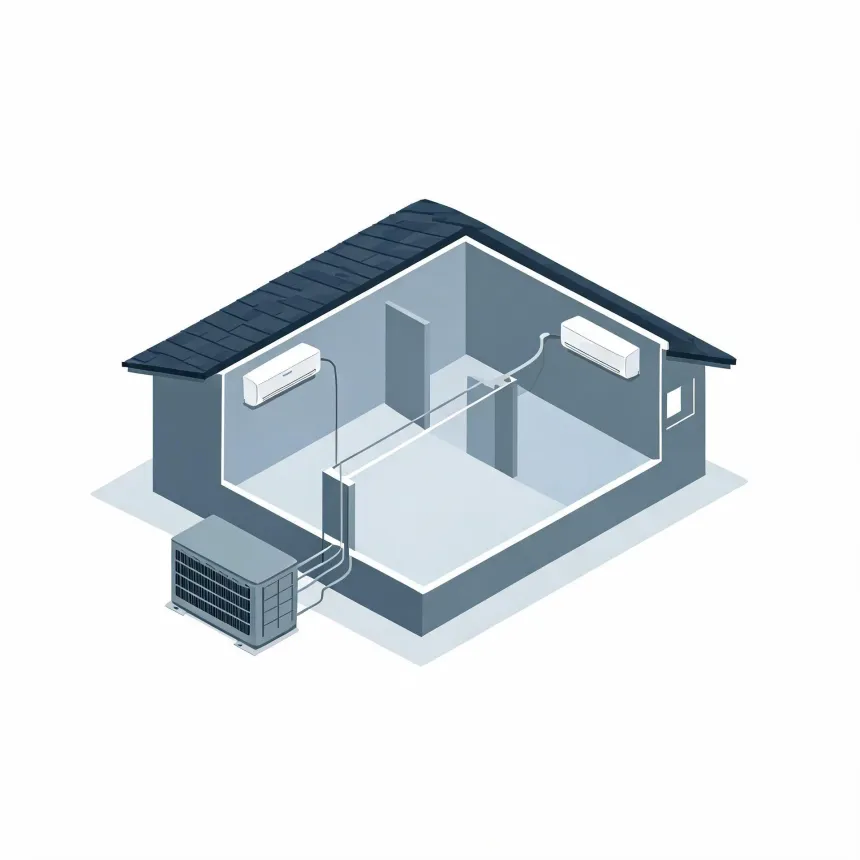
A mini-split install is priced by what it takes to get refrigerant moving correctly between the outdoor unit and every indoor head, and that work scales with how many heads there are and how far the lines have to run. Each indoor unit needs its own line set, its own condensate drain, and its own spot on a wall or ceiling with clearance to move air. More heads means more line sets, more penetrations through the wall, and more time spent making each connection right. Line length and the path it takes matter too. A run that has to go up through an attic or across a long exterior wall takes more material and more labor than one where the outdoor unit sits a few feet from the indoor head. The outdoor unit itself has to be sized to match the combined load of every head it serves, so a system feeding three or four rooms needs a larger compressor than one feeding a single room. Electrical work is its own factor. Some systems run on standard household circuits, others need a dedicated circuit and disconnect box, and whether that wiring already exists or has to be run new changes the scope of the job. Mounting matters as well. The outdoor unit needs a pad or bracket solid enough to keep it level and steady, since a unit that vibrates or shifts over time puts strain on the line set connections. However many heads a system has, the lines have to be evacuated of air and moisture and charged with the correct amount of refrigerant before it's turned on. That step is what determines whether the system runs efficiently for years or struggles and wears down early.
The efficiency number on the label comes from running the system across a full range of temperatures, not from one ideal condition. A mini-split works hardest at the extremes, deep summer heat or a cold snap, and coasts the rest of the time. The rating averages all of that into one figure so two systems can be compared fairly.
A mini-split that does not have to work as hard to move the same heat puts less load on the compressor and the fan motors. Compressors fail from heat and strain more than from age alone. A unit rated well above the minimum is built to hit its numbers without running flat out, which is also the condition that keeps a compressor alive longest.
A mini-split has to be sized to the room, not guessed at. Too big and it cools the air fast without pulling the moisture out, so the room feels clammy even after the temperature drops. It also short cycles, shutting off before it finishes a full run, and every start and stop wears on the compressor more than steady running does. Too small and it runs constantly, straining to keep up on the hottest or coldest days without ever reaching the set temperature. Getting it right means working out the heat gain and heat loss for the specific room, the windows, the insulation, the ceiling height, not just the square footage. A contractor measures that before quoting a unit, because the right size is what makes the rest of the system work the way it is rated to.
Installation day starts with the outdoor unit going on its pad or bracket, set and leveled before anything else happens. From there the installer runs the line set to each indoor head, drilling a clean penetration through the wall and sealing it once the lines are through. Each indoor unit gets mounted, leveled, and connected to its own line set and condensate drain. Once everything is in place, the whole system gets evacuated with a vacuum pump to pull out air and moisture, because either one left in the lines will ruin the refrigerant charge over time. Only after that vacuum holds does the installer open the lines and charge the system to the exact weight the manufacturer specifies. The last step is running the system through its paces, checking airflow at every head and confirming the temperature split between the air going in and the air coming out, before calling the job done.