Three white clapboard houses with wraparound porches glow with warm interior and landscape lighting beneath Spanish moss-draped oak trees at dusk.

Mini Split Installation in Grovetown, GA

Tell us about the job

Takes about a minute. No obligation.

New system or replacementMini-splitColumbia County, GA
Step 1 of 2

What ZIP code is the job in?

Weather here is hard on outdoor equipment

Columbia County logged 121 severe weather events between 2015 and 2024, most of them damaging wind. A mini split's outdoor unit sits outside year round, so where it gets mounted and what shields it from wind-blown debris and hail is worth deciding before install, not after.

Power doesn't always come right back

Nearly a third of Georgia households went at least 24 hours without power at some point in 2024. A mini split needs electricity to run, so an outage means no heat and no cooling until the power is back.

5 months
November through March, your system heats
5 months
May through September, it cools
37°F
the average winter night it heats against
90°F
the average summer afternoon it cools against
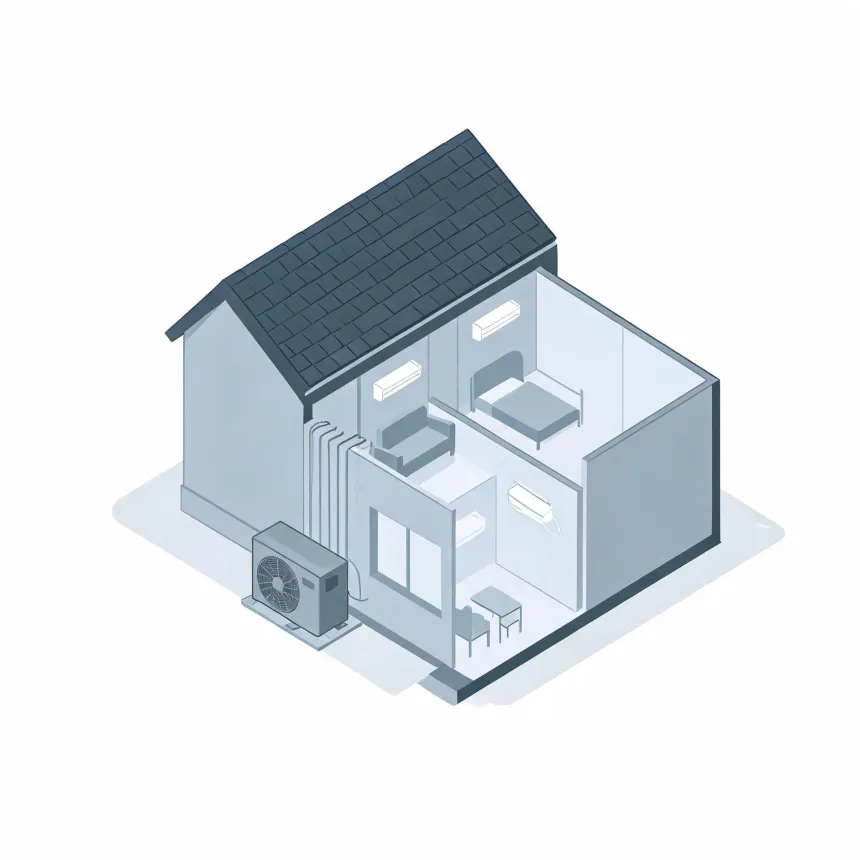
Isometric illustration of a cutaway house with a dark shingled gable roof, showing interior rooms with a bed, chairs and table, three wall-mounted mini-split indoor units connected by line sets to an outdoor condenser unit on a pad outside.
Your system heats November through March and cools May through September.

NOAA nClimDiv, 1991–2020 normals

Georgia homes paid 14.08 cents per kilowatthour in 2024.

A mini split uses less power to heat and cool than older equipment, so that rate works less against you.

Five months of summer at 90 degrees, and wind that doesn't let up

Cooling runs May through September
Summer afternoons average 90°F
92 damaging wind events from 2015 to 2024
Get it installed before MayCooling runs May through September here, so April is the month to have it in and running.

Look for the efficiency rating before anything else on the spec sheet. A mini split's SEER2 and HSPF2 numbers tell you how much power it needs to move a degree of heat, and the higher ones cost more up front. At 14.08 cents per kilowatthour, that difference shows up on every bill a mini split runs on, not just a few. If you're comparing units side by side, put the rating next to the price and weigh them together instead of picking on price alone. The one that costs less to buy isn't always the one that costs less to run.

This is an electric-heat county, and a mini split fits that

Most homes in Grovetown heat with electricity already. A mini split runs on electricity too, so it slots into a panel and a home already set up for it, without the gas line question that comes with other options.

Find a contractor
A man in a dark cap, gray T-shirt and brown work pants climbs porch steps toward an orange front door, carrying a worn canvas tool bag, with a potted shrub beside the entry.
A white mini-split air conditioner outdoor condenser unit mounted on metal brackets against a beige stucco exterior wall, with a blue sky and scattered clouds in the background.

Summers here don't let a mini split coast

Five months of outdoor unit running at a 90 degree average high is real load, every summer, for as long as you own it. That's the argument for sizing the unit to this house instead of matching the one that's coming out. A unit sized for a milder climate runs longer hours here just to keep up, and it shows the wear sooner. Get a load calculation done on the house, not a guess based on square footage or what was there before, and weigh that against the rating on the spec sheet before you decide which unit to buy.

How many zones you're conditioning

Each indoor head needs its own line set run to the outdoor unit, and its own spot on the wall or ceiling picked for airflow, not just convenience. A single zone is a straightforward run. Add rooms and you're adding line sets, more refrigerant, and an outdoor unit sized to carry all of them at once, which changes the job well before anyone talks about the equipment itself.

What the line set has to get through

The refrigerant lines running between the indoor head and the outdoor unit have to pass through a wall, and sometimes through framing, brick, or siding to get there. A straight shot through a stud wall is quick work. A longer run, a brick exterior, or a path that has to dodge structural framing takes more time and more care, and that's before the unit on either end gets mounted.

SEER2 and HSPF2 only measure what happens when the unit is running steady, moving heat at a constant rate in a lab. Your house never asks it to do that. Every time it cycles on, ramps up, or throttles down to match the room, it's working outside that neat number. A unit that modulates smoothly, stepping its output up and down instead of just switching on and off, holds closer to its rated efficiency through all of that. One that only knows on and off loses ground every time it cycles. So the rating on the sheet is a ceiling, not a guarantee, and how the unit actually behaves in your rooms decides how close you get to it.

Installation day starts with the outdoor unit placement and the line set path, both decided before anyone picks up a tool. The installer mounts the outdoor pad or bracket, sets the unit level, and runs the line set, the power whip, and the condensate drain from there to each indoor head. Wherever the line set passes through the wall, that hole gets sealed against weather and pests once the lines are through it. After the indoor heads are mounted and connected, the system gets evacuated with a vacuum pump to pull out air and moisture before refrigerant ever goes in. Moisture left behind in the lines turns to acid and corrodes the system from the inside over time, so this step gets skipped at the installer's peril, not the homeowner's. Once the system holds a vacuum, the installer charges it, powers it up, and checks airflow and temperature at each head before calling the job done.