A minimalist bedroom with dark grey walls, a large bed with charcoal bedding, a sleeping cat, two warm-toned wall sconces, and a wall-mounted air conditioning unit.

Mini Split Installation in Mableton, GA

Tell us about the job

Takes about a minute. No obligation.

New system or replacementMini-splitCobb County, GA
Step 1 of 2

What ZIP code is the job in?

Cobb County sees its share of severe weather

Cobb County logged 105 severe weather events between 2015 and 2024, including 70 damaging wind events, 22 hail events, 4 tornadoes, 3 tropical storms or hurricanes, and 5 winter storms. Nearly a third of Georgia households went at least 24 hours without power in 2024.

An outdoor unit sits exposed to all of it

The outdoor unit for a mini-split lives outside year-round, where wind-driven debris and hail can reach it. An outage knocks out the compressor along with everything else in the house, so the heating and cooling this system provides stops when the power does.

6 months
November through April, your system heats
5 months
May through September, it cools
34°F
the average winter night it heats against
88°F
the average summer afternoon it cools against
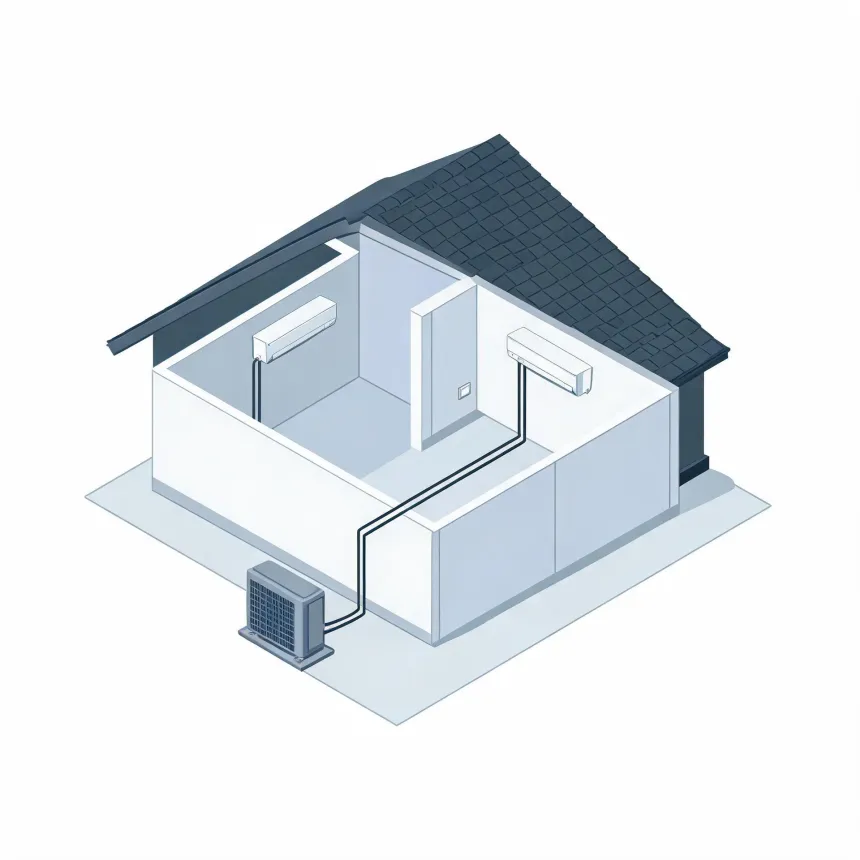
Isometric cutaway illustration of a small house with a dark shingled roof, showing two wall-mounted indoor air conditioning units in separate rooms connected by lines to an outdoor condenser unit on the ground outside.
Your system heats November through April and cools May through September.

NOAA nClimDiv, 1991–2020 normals

The old system doesn't just get switched off, it has to be recovered and disposed of properly.

Refrigerant in the old lines has to be recovered by a licensed tech before anything gets cut apart or hauled away.

Most homes near Mableton heat with gas, which is why a mini-split usually joins the system rather than replacing it

68.2% of homes heat with gas
Cooling runs May through September
Summer afternoons average 88°F
Get it in before MayCooling runs May through September here, so April is the month to have it ready.

Cobb County falls in climate zone 3A, warm with a long humid summer, and that rating sets a floor on what can be installed. Under the federal standard, a mini-split counts as a split-system heat pump, so any unit built from January 1, 2023 onward has to deliver at least 14.3 Btu of cooling for every watt-hour it draws over the summer, and at least 7.5 Btu of heat per watt-hour over the winter. That's not a target a contractor aims for. It's the minimum the equipment has to clear before it can go in the ground. A federal tax credit is available on qualifying systems, on top of whatever that efficiency saves on the power bill.

Plan for the outage before the install, not after

Pick the mounting spot with wind and hail in mind, and ask what the installed system will and won't do if the power goes out. That's a decision made at install, not after a storm's already come through.

Find a contractor
A man in a gray long-sleeve shirt and work pants carries a canvas tool bag as he climbs porch steps toward an orange front door of a gray clapboard house, with a potted shrub to the right.
A white mini-split air conditioner outdoor condenser unit mounted on metal brackets against a beige stucco exterior wall, with a blue sky and scattered clouds in the background.

What to ask before you sign anything

Any contractor can quote a single number for capacity and call it done. Ask instead how they arrived at it. A mini-split has to be sized to the room or zone it serves, using the square footage, the window area, the insulation, and how that space is used. Too big and the unit short cycles, cooling the room fast then shutting off before it pulls the moisture out of the air, leaving it cold and damp. Too small and it runs constantly without ever catching up. Ask whether the line set length and the number of bends were accounted for, since both affect how well refrigerant moves between the outdoor unit and the indoor head. Ask where the outdoor unit will sit and why that spot was chosen, since airflow around it affects how hard the compressor has to work. Ask what happens to the old equipment and who is certified to handle the refrigerant in it. And ask what the warranty actually covers, parts, labor, or both, and for how long, because a system installed wrong can fail inside a year even with good equipment.

Where the line set runs decides a lot

The indoor head and the outdoor unit connect through a line set carrying refrigerant and a drain for condensate. That path has to run through a wall or along it, down through a soffit, or up through an attic, and whichever way it goes, something gets opened up and closed back in. A longer run or extra bends mean more work and more refrigerant to charge the system with.

The wall it hangs on matters as much as the unit itself

An indoor head needs a clear run to the outside for its line set, a wall that can hold its weight, and placement away from doorways and furniture so the airflow actually reaches the room. The outdoor unit needs a pad or bracket, clearance on all sides, and a path for the electrical whip and disconnect box run to it. Getting that placement wrong doesn't show up until the system is already in and running poorly.

Sizing a mini-split starts with a load calculation, not a tape measure. A contractor works out how much heat the space gains in summer and loses in winter, using the square footage along with window area, insulation, ceiling height, and air leakage. That number drives which indoor head and which outdoor unit go in. Get it wrong on the high side and the unit blasts the room down to temperature and shuts off before it has run long enough to pull the humidity out of the air, so the room feels cold and clammy at once. Get it wrong on the low side and the compressor runs nearly nonstop, straining to reach a setpoint it can't hold on the hottest or coldest days. Either mistake wears the equipment harder than running it at the size it was built for.

Installation day starts with the load calculation already done and the equipment on site, so most of the day goes to the physical work. The crew mounts the indoor head on its bracket first, then drills through the wall for the line set, the drain line, and the electrical cable, usually in one pass so there's only one hole to seal. Outside, the outdoor unit goes on a pad or a wall bracket set level and clear of the eaves. Once both ends are in place, the line set gets connected and the tech pulls a vacuum on the lines to clear out air and moisture before any refrigerant moves through them. Skipping that step is one of the most common reasons a new system runs poorly from day one. After the vacuum holds, the system gets charged, powered up, and run through its paces, heat and cooling both, while the tech checks the temperature split at the head and looks for any sign the line set or drain isn't sealed right.